

Kiplot vs Planview: An enterprise alternative for Strategic Portfolio Management

An enterprise-focused comparison for organizations evaluating Planview competitors for Strategic Portfolio Management.
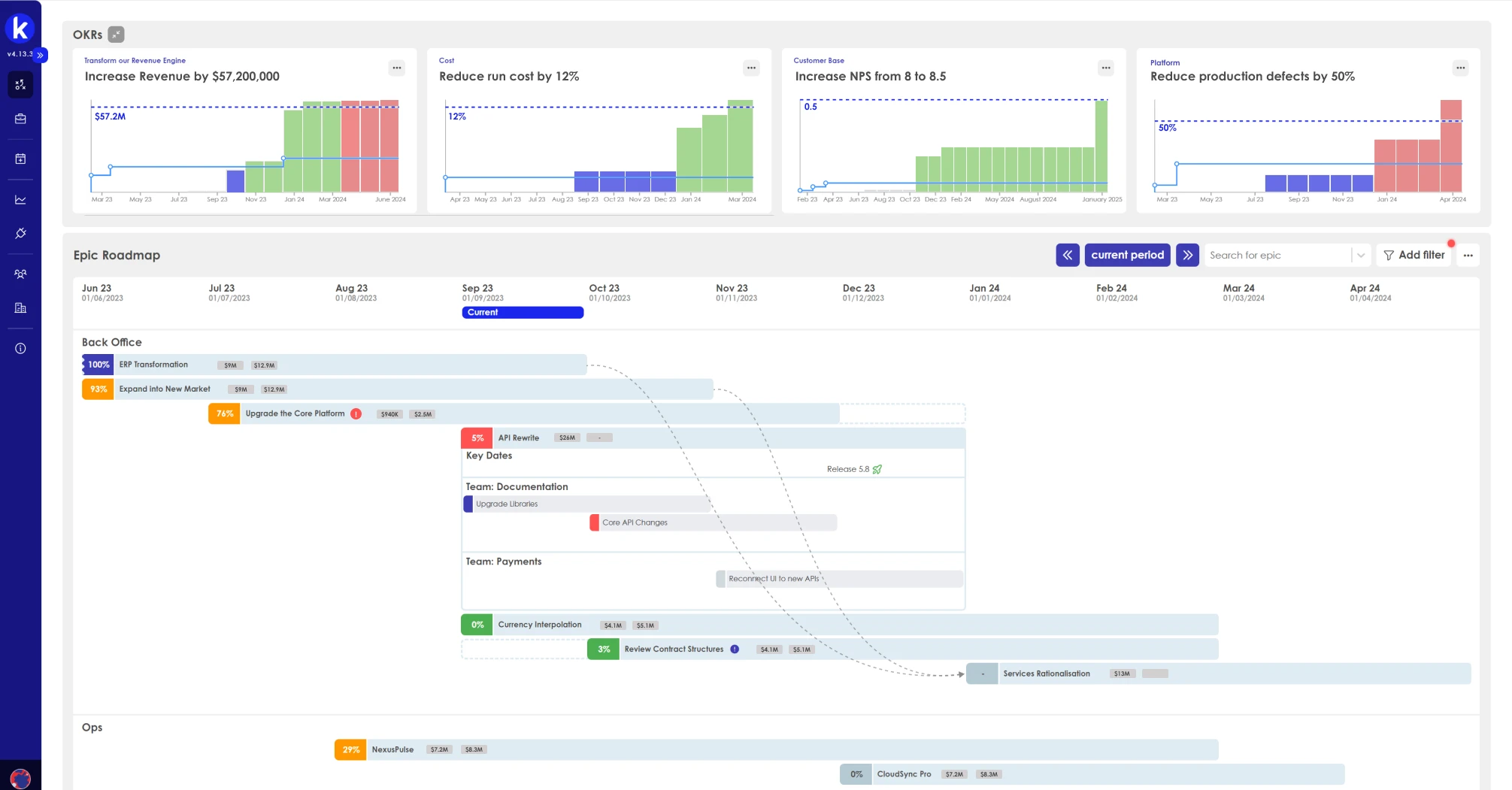

Kiplot Strategic Portfolio Management interface showing portfolio roadmap and reporting

Our Customers

Overview Of This Comparison

Planview is widely used across large organizations to support portfolio governance. As Strategic Portfolio Management becomes ever more critical, they need a tighter connection between strategic priorities, funding models, capacity constraints, and delivery evidence across Jira, Azure DevOps, and finance systems. Many organizations reassess Planview when, in practice, portfolio governance becomes services-dependent, reporting becomes specialist-owned, or financial controls require additional layers to maintain auditability.

This page provides an enterprise-focused comparison of Kiplot and Planview to support assessing Planview alternatives and competitors in the context of Strategic Portfolio Management.

Who Is This Comparison For

Relevant roles

  • CIO, CTO, CFO, COO
  • Head of Strategy, Transformation, or Change
  • Enterprise PMO and Portfolio Governance leaders
  • Portfolio, Programme, Product, and Value Stream leaders

Relevant situations

  • Existing Planview customers approaching renewal or reassessment
  • Organizations operating hybrid delivery models
  • Teams seeking clearer portfolio-level financial and capacity visibility
  • Teams running a structured vendor evaluation or RFP process

Comparison: Kiplot and Planview

Kiplot and Planview both support enterprise portfolio management across strategy, funding, and delivery.

The comparison below focuses on how each platform applies flexibility, where complexity typically sits, and how organizations experience implementation, governance, and time to decision-grade insight in practice.

Kiplot
Planview
Time to implement Weeks Often years
Jira / Azure DevOps Integration Flexible, bi-directional, plug-and-play,
no technical skills required
Rigid, customization
and technical skills often required
Configuration model No-code by business users Consultant-led customization.
Reporting Board-ready, self-serve,
proprietary, no code
Specialist build or services.
PowerBI licenses and expertise required.
Financial governance Advanced project accounting built-in;
CapEx/OpEx, depreciation, accruals
Available - customization
typically required
Resource management Drag-and-drop, waterfall,
agile and hybrid methodologies
Highly complex; unrealistically
high levels of maturity required
End-user adoption Bleeding edge technology,
modern UX; rapid adoption
Complex UI; training heavy
with 35 years of legacy technology

Time to implement

Kiplot

Weeks

Planview

Often years

Jira / Azure DevOps Integration

Kiplot

Flexible, bi-directional, plug-and-play, no technical skills required

Planview

Rigid, customization and technical skills often required

Configuration model

Kiplot

No-code by business users

Planview

Consultant-led customization

Reporting

Kiplot

Board-ready, self-serve, proprietary, no code

Planview

Specialist build or services. PowerBI licenses and expertise required

Financial governance

Kiplot

Advanced project accounting built-in; CapEx/OpEx, depreciation, accruals

Planview

Available - customization typically required

Resource management

Kiplot

Drag-and-drop, waterfall, agile and hybrid methodologies

Planview

Highly complex; unrealistically high levels of maturity required

End-user adoption

Kiplot

Bleeding edge technology, modern UX; rapid adoption

Planview

Complex UI; training heavy with 35 years of legacy technology

What Organizations Gain With Kiplot as a Planview Alternative

Four reasons organizations choose Kiplot over Planview: modern technology, rapid deployment, internal ownership, and hybrid delivery control.

Modern platform, no legacy baggage

Planview means operating on an architecture shaped by 36 years of extensions and acquisitions; Kiplot is a modern platform built without legacy constraints.

Fast to deploy, faster time to value

Planview adoption often requires extended onboarding before broad day-to-day use. Kiplot is built for immediate adoption by teams and faster time to value.

Configure and adapt without consultants

With Planview, evolving governance and reporting typically depends on specialist skills; Kiplot is configured, adapted and owned directly by your internal teams.

Built for hybrid delivery at scale

Planview was established in an era of structured, traditional operating models; Kiplot is purpose-built for modern hybrid portfolios spanning agile and traditional delivery.

See How Kiplot Compares to Planview

Adopt Kiplot Without Disrupting Existing Systems

Kiplot is designed to act as a strategic decision and governance layer, sitting between delivery tools and enterprise financial systems. This allows organizations to introduce portfolio-level clarity without replacing existing execution or ERP platforms.

1.

Controlled integration

Kiplot integrates with Jira, Azure DevOps, and existing portfolio data sources, enabling teams to introduce it as a decision and governance layer without changing delivery tools.

2.

Incremental adoption

Many organisations start with a single portfolio, funding model, or executive view, then expand usage as confidence and value grow.

3.

Controlled transition

Where replacement is required, migration can be staged by portfolio, function, or governance layer, reducing delivery and political risk.

Integrate Kiplot With Your Existing Tools

Portfolio Transformation Case Studies

RAKBANK strengthened its strategic portfolio management capability to increase delivery confidence and maintain financial control in a regulated environment.

Kiplot is enabling us to accelerate agile execution while ensuring every initiative has clear accountability, transparent governance, and alignment to our strategic priorities.
Read the full case study

TSB executed a £100M cost-saving programme by strengthening strategic portfolio management to improve delivery transparency, value alignment, and financial control during its transformation.

Kiplot has been a key enabler to our agile transformation agenda, driving efficiency, productivity and speed. We returned our initial investment in less than 1 year.
Read the full case study

FAQs From Organizations Evaluating Planview Alternatives

How long does it take to implement Kiplot compared to Planview?

+

Kiplot is typically introduced incrementally, often starting with a single portfolio, governance view, or executive reporting layer. Many organisations see usable portfolio insight within weeks rather than months, without requiring a full platform rollout upfront.

Is Kiplot a Planview alternative for enterprise Strategic Portfolio Management?

+

Yes. Kiplot is designed as an enterprise Strategic Portfolio Management platform for organizations evaluating alternatives to Planview in the context of portfolio governance, funding control, and delivery alignment at scale. It supports prioritization, funding models, capacity constraints, and decision traceability across hybrid delivery environments without requiring extensive services-led configuration. Organizations typically consider Kiplot as a Planview alternative when they want portfolio governance, financial control, and executive reporting to be owned by business and finance teams, rather than centralized specialists.

Do we need to restructure Jira, Azure DevOps, or ServiceNow?

+

No. Kiplot integrates with existing delivery and service management tools as they are. Teams continue working in Jira, Azure DevOps, or ServiceNow, while Kiplot provides portfolio-level visibility and control above them.

Can Kiplot support enterprise-scale financial governance?

+

Yes. Kiplot supports portfolio-level financial governance, including budgeting, forecasting, cost tracking, and value realisation, designed to meet the needs of regulated and finance-led environments.

Who owns configuration and reporting over time?

+

Kiplot is designed so that portfolio configuration and reporting can be managed by internal teams. Routine changes to models, views, and governance do not require specialist skills or ongoing consultant dependency.

Can Kiplot scale across global, hybrid delivery models?

+

Yes. Kiplot supports traditional, agile, and hybrid delivery models across distributed teams, enabling consistent portfolio governance while allowing local delivery practices to continue.

Is this a rip-and-replace decision?

+

No. Most organisations adopt Kiplot incrementally. Some use it as a complementary decision and governance layer; others expand usage over time as confidence and value increase.

How is Kiplot designed to support financial services organizations?

+

Kiplot is designed around the portfolio governance, financial control, and auditability requirements commonly found in regulated financial services environments. It supports structured funding models, clear initiative ownership, and traceable portfolio decisions across CapEx and OpEx without relying on informal workarounds or offline reporting.

The platform provides role-based access control, controlled configuration, and an audit trail over portfolio and financial changes, enabling organisations to demonstrate how investment decisions are made and adjusted over time. Financial structures are consistent across planning, prioritisation, and delivery, supporting alignment between portfolio teams, finance, and risk functions.

Kiplot integrates with existing delivery tools and enterprise finance systems, allowing banks and insurers to strengthen portfolio-level governance and decision confidence without disrupting established operating models or regulatory controls.

Evaluate Kiplot as a Planview Alternative