








For years, portfolio management had a clear shape: stage-gate approvals, monthly governance reviews, and quarterly planning cycles. That model made sense when delivery was largely linear, scope was set upfront, and change was controlled through formal processes.
That is no longer how most organizations operate. Today, waterfall, agile, and hybrid delivery models often coexist inside the same portfolio, sometimes inside the same business unit. Yet many organizations are still trying to govern that reality with one of two incomplete models: traditional portfolio controls on one side, or team-level delivery tools on the other.
Neither is enough. One was built for a slower, more predictable world. The other was built to help teams execute, not to help leadership steer across strategy, delivery, capacity, and finance.
That is why so many portfolio challenges now look different on the surface but share the same underlying cause: the organization has no connected management view across the things that actually determine outcomes.
Below are five challenges we consistently see enterprise organizations facing. Each one feels like a separate problem. However, they share the same root cause: the portfolio is being managed through disconnected systems and disconnected views of strategy, delivery, capacity, and finance. That is why solving them one at a time rarely works.
1. Reporting takes days and is still out of date by the time it is ready
It is common for organizations to track different parts of their portfolio in different tools. Business cases sit in spreadsheets, initiatives in Jira, risks in PowerPoint, and strategic objectives in a separate system, all without a live connection to delivery. When leadership needs a portfolio view, someone must piece it together through manual data archaeology. They pull data from each source, reconcile it, clean it, and compile it into a PowerPoint presentation.
This is often treated as a reporting problem. In practice, it happens because the portfolio does not exist as a current management view. Each reporting cycle starts with the same manual task: reconstructing a picture of the portfolio from disconnected sources, which means leadership is making decisions on a picture that is already out of date.
2. Jira and Azure DevOps work for delivery teams, but they do not create portfolio visibility
Delivery teams maintain well-organized Jira or Azure DevOps boards, track epics and sprints, and manage their backlog. However, business units not working in those tools have limited visibility into delivery.
The result is that the organization is simultaneously over-informed and under-informed. Delivery teams know the specifics of their work, but they do not see where it fits into the overall portfolio. Leadership understands the big picture but does not have a strong connection to what is happening on the ground. Initiatives that require input from IT, legal, and sales at the same time are often not tracked in a manner that makes those dependencies clear to everyone involved.
Team-level tools are built to help technical teams manage execution. Making that execution legible to the rest of the organization is a different requirement entirely, and not one those tools were designed to meet. When no connected view exists between those two worlds, delivery can be well managed and still become progressively less visible at the portfolio level, with teams speaking in delivery metrics and leadership asking portfolio questions those tools were never designed to answer.
3. Resource allocation is happening without a portfolio-wide view of supply and demand
On the surface, most organizations have a resource management process in place. In practice, the information needed to run it properly is rarely in one place. Supply estimates and demand forecasts live in different spreadsheets, and the people managing each part work at different paces. They lack a shared view of the entire picture.
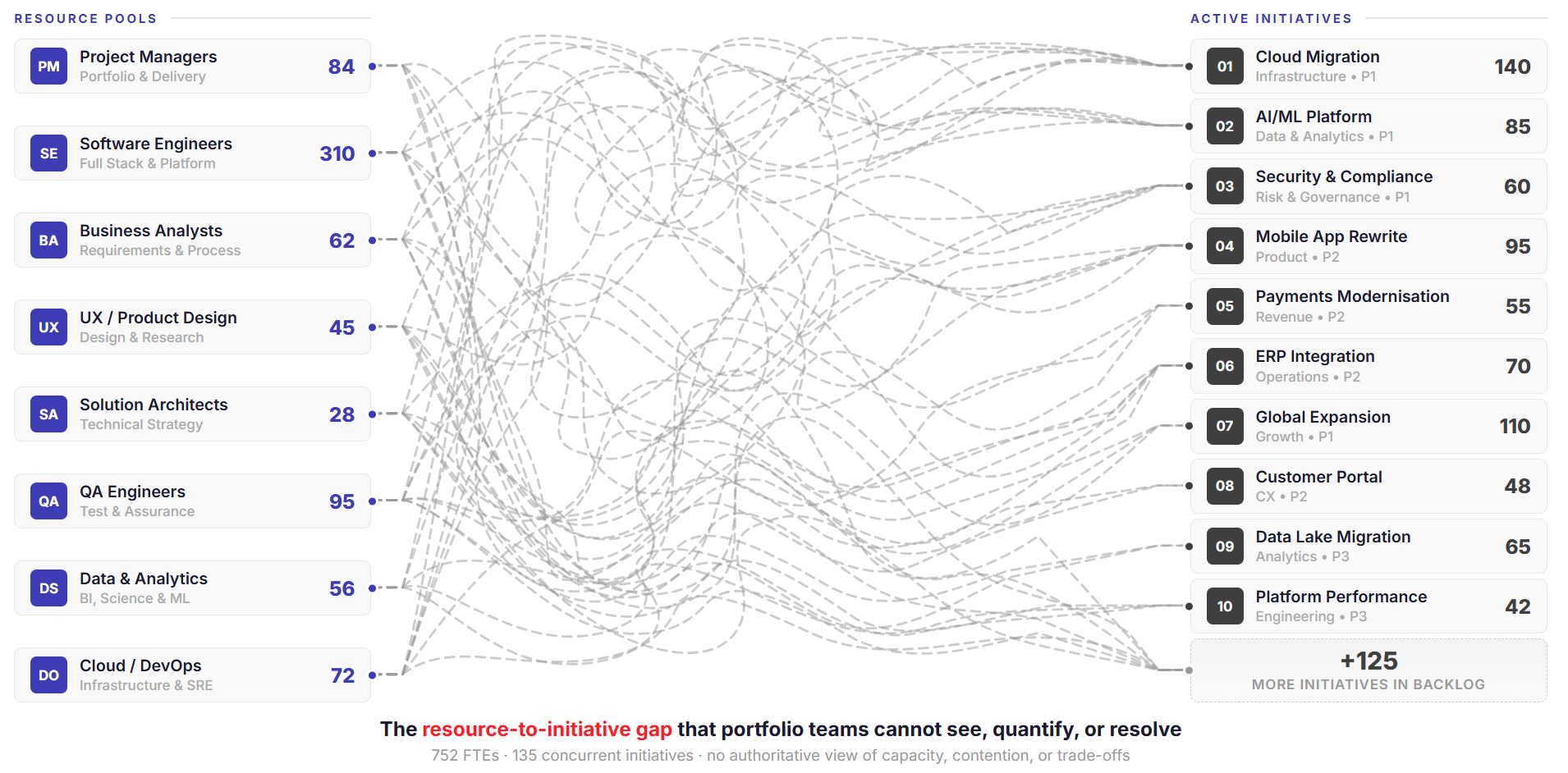
Without a shared view, allocation stops being a rational process. Initiative leads make capacity assumptions within their own workstreams without visibility of what has already been committed elsewhere. The same resource ends up being requested across more initiatives than they can realistically deliver. Organizations commonly describe the outcome as the loudest voice winning when it comes to resource allocation.
This, however, is not purely a resource problem. It happens when supply, demand, and existing commitments are not managed in one connected portfolio view. Capacity decisions then get made within individual workstreams, with no reliable view of what the same people or teams are already committed to elsewhere in the organization. That is why conflicts are usually discovered only after they have already become delivery problems.
4. Finance and delivery are being reconciled manually
Most organizations forecast initiative costs in one system and track delivery progress in another, with no automated connection to actuals. Human resource costs are often reported in hours only and never converted to a financial value. Finance and delivery end up running parallel processes, reconciled manually, usually by one person, usually in a spreadsheet.
While this is often described as a process problem, it is a structural one. Many traditional portfolio management financial models assume a level of scope and cost stability that hybrid delivery no longer provides. The cost baseline is set at stage-gate approval and actuals are tracked against it - a model that assumes delivery unfolds linearly, which in most hybrid portfolios it no longer does.
In those circumstances, the spreadsheet becomes the only thing holding finance and delivery together.
5. Existing solutions amplify the problem
Most organizations have already spent significant time evaluating options, running proofs of concept, and in some cases completing full implementations of enterprise platforms that ultimately did not solve the underlying problem.
These evaluations tend to reach one of two conclusions. Either the solution is too administratively heavy to reflect how the organization actually works. Or it is well-designed for team-level execution and task management, but cannot answer the portfolio-level questions that leadership is asking.
So organizations end up layering. A delivery platform here. A financial system there. A capacity planning application somewhere else. Each one solves its local problem reasonably well. But each one also adds another system that needs to be reconciled with the others, which means more manual effort, more spreadsheets in the middle, and more opportunities for the data to diverge.
The problem sits in the gaps between systems, not inside any one system. Adding more point solutions without addressing those gaps increases the reconciliation burden rather than reducing it. That is what amplifies the problem rather than solving it, and why the answer is not another system at the same level, but something that works across all of them.
For further insight, read this article on Enterprise Architecture.
Conclusion
Many organizations keep searching for a solution that never comes, or accept these challenges as a normal part of operating at scale. They don't have to.
These five challenges look different on the surface: reporting delays, poor visibility, resource conflict, manual financial reconciliation, and disappointing implementations. But they share the same underlying cause: the portfolio is being governed through disconnected systems and disconnected management views.
For organizations still stitching strategy, delivery, capacity, and finance together manually, Strategic Portfolio Management offers a different approach. Not another reporting layer, and not a push for delivery teams to abandon the tools they already use.
It creates the layer that is missing today: a connected portfolio view that brings financial data, delivery progress, capacity, and strategic context together in one place, so leadership can govern the portfolio as it actually operates.
Read more about Strategic Portfolio Management.