



On this page
Agentic AI (systems that pursue an outcome, not just answer a question) can already do large parts of the traditional PMO's work: chasing updates, formatting packs, drafting reports and business cases, even monitoring a portfolio for risk. If that does not feel true inside your organization yet, it is because you have not adopted it, not because the technology is not ready.
That does not make the PMO redundant. It makes the administrative PMO redundant.
AI will not replace the PMO. It will replace PMOs that do not adapt. The rest of this article is really about one question: what does it mean to adapt?
The difference is not better answers, it is action
The tools most of us use day-to-day, ChatGPT and Copilot, are assistants. Agentic AI, such as Claude Code, is something different. Where traditional AI answers the question you ask, agentic AI works, often independently, toward the outcome you want.
Think of it as two models. In the old model, AI is a writing assistant: it helps you say or write something. In the new model, AI is a delivery assistant: it helps you actually do the thing.
The old model · Assistant
It helps you say a thing
- Rewrites a paragraph or improves some wording
- You paste in text or upload a file
- Answers the prompt you give it
- You manage every step: prompt, read, prompt again
The new model · Agent
It helps you do the thing
- Produces the deliverable and completes the task
- Works across your tools and files
- Pursues the outcome, not just the prompt
- You set direction and controls; it works, then returns to you
This matters because almost anything that involves using a computer, agentic AI can now do, and in many cases, faster and more effectively than people. You set the direction, define the level of control you require, and the agent works away, coming back to review or to ask permission where needed.
What agentic AI can already do
Connected to the systems an enterprise already runs on (inbox, HR, portfolio tooling, project data, financials, risks, dependencies, resource plans and meeting notes), agentic AI can already do the following. The list climbs, from the mechanical to work that looks a lot like judgment:
Administrative
- Reformat messy project updates into a standard status template
- Check project data for missing fields, inconsistencies and obvious quality issues
Coordination
- Chase project managers for overdue updates, missing risks, stale milestones or unconfirmed actions
- Produce weekly status reports from project data, meeting notes and recent delivery activity
- Maintain an action log: capturing actions, assigning owners, tracking due dates and chasing completion
- Review emails, notes and updates to surface dependencies, risks and decisions not formally logged
Analysis and judgment
- Assess whether a project fits the current architecture, governance, funding approach and delivery constraints
- Monitor a portfolio continuously, flag emerging risks, challenge inconsistent reporting and prepare executive decision packs
Sound familiar?
The truth gets harder to find
When AI can already do large parts of PMO work, does the PMO become redundant? Quite the opposite: because AI makes almost every kind of organizations work faster, it creates three serious problems, and all of them sit in the heartland of the PMO.
The first is that the truth gets harder to find. AI makes it almost effortless to generate updates, reports, summaries, business cases, risk narratives and steering packs. When everyone can create polished, confident information instantly, the PMO's job changes: no longer gathering enough information, but finding the truth inside too much of it.
We are all familiar with the old PMO cliché: watermelon reporting. Green on the outside, red on the inside. A good-looking status report that obscures the true state of a project until it is too late. Left to its own devices, widespread AI will make this worse. It will make the watermelon shell thicker, and harder to see through.
Consider a typical AI-polished executive summary:
"The program continues to make measured progress against its core delivery objectives, with steerco maintaining appropriate oversight across scope, cost, timing and delivery confidence. Critical path activity remains under active review, with key interdependencies tracked through established governance forums. The £8M budget and operating readiness plan continue to be monitored. Overall, the initiative remains actively managed through its delivery lifecycle."
It references an £8M budget, the critical path, interdependencies and sponsor oversight. On first read it sounds credible. But remove the £8M figure, and it could describe almost any project running anywhere in the world.
Most organizations already struggle with reporting: late, inconsistent, too optimistic. The instinct has always been that if only we had more updates, more often, with better wording, the picture would be clearer. AI changes that equation.
The issue may no longer be too little reporting, but too much of it, all of it perfectly written. That is a much harder problem, and it is the PMO's job to protect the organization from it.
There are three tactics for evidence-led reporting.
Make reporting evidence-led
Do not ask for a "clear executive summary"; AI is exceptional at producing something that merely sounds clear. Ask for the evidence. How many milestones moved this month? Which risks increased in severity? What is the current forecast against the original business case? And fight fire with fire: use AI to validate the summary. "Connect to our portfolio tooling and check the metrics in this executive summary."
Define what RAG actually means
Too many organizations treat RAG as a mood: green means the project manager feels broadly comfortable, red means the problem became impossible to hide. That will not survive AI. RAG has to be tied to observable conditions, so AI can challenge a status rather than make it sound more convincing.
Illustrative. The point is that each status maps to an observable condition, not to how the project manager feels.
Make the PM a contributor, not the author
The project manager should no longer be the primary author of the update. The update should be generated from the underlying initiative data; the project manager then challenges it, comments and adds context. If the narrative is derived from the evidence first, AI becomes part of the assurance layer rather than a better way to tell the story the project manager wants the organization to hear.
Build first, align later
AI can build almost anything before anyone has approved it. But does it fit the strategy? Is it secure? Who owns it? Does it duplicate something already underway?
This is already happening across the organization. Finance automates its reporting, marketing builds a customer journey it has wanted for months, operations creates a workflow to clear a backlog, and HR puts together its own onboarding process. All of it starts with a real problem and a sincere attempt to solve it, and all of it is now the work of an afternoon.
What grows out of this is a layer of shadow systems: working tools and processes that touch real customer data and real money without ever having been formally chosen. They build up until the organization comes to depend on software and workflows that no one approved and few people fully understand.
The cost tends to arise later. A reporting automation that no one documented stops working the week its author moves teams, and a customer journey built outside the review process can mishandle consent long before anyone notices. By that point, the work is load-bearing enough that unpicking it becomes a project in its own right.
People take this route because the official one asks more of them than the task seems to warrant. When approval takes weeks and the build takes an afternoon, the informal path becomes the reasonable choice, and tightening the controls tends to push it further out of sight. The role of the PMO is to make the supported route the quickest one available, so that using it becomes the natural thing to do.
Handled well, this same speed is a genuine advantage. An idea can now be built and tested in hours, which lets the organization learn early and commit real money only once something has proven itself. Getting there depends on the PMO building a proper front door for this work, which means rethinking the delivery lifecycle itself.
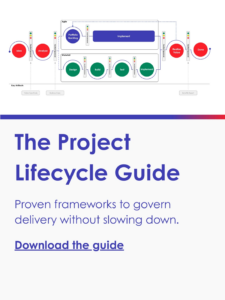
Most delivery lifecycles are linear and approval-heavy. An idea is analyzed, a business case is approved, and only then does build begin, split across parallel waterfall and agile streams. The trouble is that most of the uncertainty is carried deep into delivery. Little has been tested by the time the money is committed, so problems surface late, when they are most expensive to fix.
Before: the standard lifecycle
Most of the uncertainty is carried deep into delivery. Little is tested before the money is committed, so problems surface late, when they cost the most to fix.
After: front-loaded for prototyping
Prototyping and review move to the front, so more uncertainty is resolved before the business case. What reaches approval is a tested proposition, and the delivery stages get shorter.
The fix is to re-sequence it. "Analyze" expands into "Prototype" and a "Review and Refine" stage that resolves more uncertainty before the business case, so the delivery streams downstream get shorter. The early stages make proper room for prototyping: can we simulate it, model it, understand the regulatory impact? The PMO's role is to orchestrate this new front end: making prototyping visible and safe, and turning early experimentation into a tested proposition backed by evidence.
Choice becomes the bottleneck
When far more ideas arrive looking credible, how does the organization decide what deserves to enter the portfolio at all?
Picture the investment process as a funnel. Ideas enter at the top. Today, organizations require a business case to approve them; once approved, the project goes into implementation, and hopefully, eventually, to live.
Today, effort is an accidental filter: plenty of weak ideas never go anywhere simply because getting any idea off the ground is hard work. Someone has to write the paper, build the cost-benefit model, create the deck, gather evidence and persuade people to take it seriously. Over time, AI removes most of that friction.
More ideas will arrive looking credible. But the organization does not suddenly have unlimited money or unlimited capacity, and customers do not suddenly have unlimited appetite for change. So the front door becomes both a floodgate and a bottleneck.
The hard question is no longer "can someone create a convincing proposal?" or even "can we deliver it?" It is: should this exist at all?
The answer is not to make the funnel narrower. If AI makes ideas cheaper to explore, more ideas should be explored. But the standard for moving through the funnel must rise.
The old model relies heavily on written business cases, and those are about to become as vulnerable as watermelon reporting: polished, confident-sounding noise. So the business case does not disappear, but its role changes. It becomes the wrapper around the evidence, rather than the evidence itself.
Investment committees now spend their time reviewing evidence: show us what works, what has been tested, and what is still unknown.
The PMO owns how the new funnel works
How ideas enter
The barrier drops, so more ideas get explored.
What evidence is required
A tested prototype or a deep piece of analysis.
Who reviews it
The right experts inspect and challenge it.
What gets approved
The PMO owns the call.
Not everything that can be done should be done. Knowing what not to build, and when to stop, is exactly the kind of judgment AI is least able to make. It is fast becoming the PMO's most valuable contribution.
The adapted PMO owns truth, flow, and choice
The PMO that exists to chase updates, format packs and administer business cases is exposed; AI will do more and more of that work. But the PMO that adapts becomes more important, not less: it moves up the value chain, from an administrative function into the orchestration layer between strategy and delivery. That orchestration layer has three jobs.
Truth
Is the portfolio narrative accurate?
When information becomes unlimited, the PMO protects the quality of the portfolio narrative. It defines the evidence base, challenges the reporting, and makes sure the organization is not fooled by polished noise.
Flow
How do ideas become governed work?
When people can build first and align later, the PMO redesigns the lifecycle. It makes room for prototyping, review and refinement, so ideas can move from experiment to evidence to governed delivery.
Choice
What deserves funding, capacity and attention?
When the front door becomes a bottleneck, the PMO helps the organization decide what deserves funding, capacity and leadership attention.
These jobs are harder in a world of abundant AI-generated work, not easier. They demand judgment, standards and orchestration rather than administration, and they sit squarely with the PMO.
The function that only owns templates and gates is exposed. The function that owns truth, flow and choice becomes one of the most valuable parts of the enterprise. That is what adapting looks like, and it is well within reach for any PMO ready to make the move.