We use cookies to enhance your browsing experience, serve personalised ads or content, and analyse our traffic. By clicking "Accept All", you consent to our use of cookies.
Preferences
Strictly Necessary
These cookies are essential for the website to function and cannot be switched off.
Functional
Enable enhanced functionality and personalisation, such as videos and live chats.
Analytics
Help us understand how visitors interact with the site by collecting anonymous information.
Marketing
Used to deliver advertisements more relevant to you and your interests.
Portfolio Prioritization
The Enterprise Guide to Portfolio Prioritization
Portfolio prioritization determines which initiatives should receive investment, which should wait, and which should stop. It creates a portfolio that reflects strategic intent and fits the funding, capacity, dependencies, and obligations that shape delivery.
Portfolio prioritization is the process of assessing current and proposed initiatives, comparing their relative importance, and deciding which combination should receive funding and delivery capacity. It applies to new demand and to work already in progress.
The decision may result in an initiative being approved, deferred, declined, paused, stopped, rescoped, or moved to a different delivery period. A complete process considers more than the merits of each initiative in isolation. It also considers whether the proposed portfolio is affordable, whether the required teams and skills are available, whether initiatives depend on each other, and whether the total investment mix supports the organization's priorities.
This guide uses the following definitions to distinguish the related activities within that process.
Term
Meaning
Project scoring
Assessing a project or initiative against defined criteria
Ranking
Ordering initiatives according to a score or documented judgment
Project prioritization
Comparing individual projects to establish their relative importance
Initiative prioritization
Applying the same comparison to initiatives or another portfolio work type
Portfolio selection
Deciding which initiatives should form part of the proposed or approved portfolio
Portfolio balancing
Reviewing whether the selected portfolio has an appropriate investment mix
Scenario planning
Comparing alternative portfolio combinations under different assumptions
Portfolio optimization
Identifying a preferred feasible combination against stated objectives and constraints
These activities produce different outputs. A project score expresses an assessment. A ranking shows relative order. Portfolio prioritization uses that evidence to form an investment recommendation. Authorization confirms the decision and allocates the required funding or capacity.
Project vs portfolio prioritization
Project prioritization compares individual projects or initiatives. Portfolio prioritization decides which combination should proceed within the organization's strategic, financial, and delivery constraints.
Dimension
Project or initiative prioritization
Portfolio prioritization
Unit of analysis
One project or initiative
A combination of current and proposed initiatives
Main question
How important is this initiative relative to comparable alternatives?
Which combination should receive funding and capacity?
Typical inputs
Criteria, scores, evidence, value, urgency, cost, and risk
Initiative assessments plus funding, capacity, dependencies, timing, obligations, and existing commitments
Main output
A score, category, or ranked position
A portfolio recommendation identifying which initiatives should be approved, deferred, declined, paused, stopped, or resequenced
Typical decision point
Intake, business-case review, product planning, or backlog review
Investment planning, portfolio review, or a material-change decision
Project portfolio prioritization applies this broader decision to a portfolio made up principally of projects. Initiative prioritization uses a wider unit that can represent projects, products, programs, regulatory commitments, or other forms of enterprise investment.
The portfolio does not need to reduce every type of work to an identical delivery model. It does need enough consistency to compare competing claims on the same money, people, and executive attention.
Why ranking is not enough
A ranked list shows the order produced by a scoring model. It does not show whether the resulting portfolio can be funded, resourced, sequenced, balanced, or authorized.
An initiative can rank highly and still need to wait, and a lower-ranked initiative may still need to proceed. The reasons, whether funding, capacity, dependencies, obligations, timing, or risk, are what portfolio selection weighs, and they are set out later in this guide.
This means that ranking and selection answer different questions.
Ranking asks which initiatives appear more important under the chosen comparison model.
Selection asks which initiatives should proceed together.
Authorization confirms the decision and its conditions.
Portfolio prioritization should preserve all three stages. Allowing a score to become an automatic approval rule hides the judgment contained in the criteria, weights, assumptions, and exceptions.
Current and proposed initiatives
In-flight workApproved work not startedNew demandMandatory commitments
Eligibility and evidence
Is the initiative sufficiently defined, supported, and ready for this decision?
Scoring and comparison
Strategic contributionExpected benefitUrgencyRiskCost and effortConfidence
ApproveApprove with conditionsDeferDeclinePause or stop
Scoring creates a comparable view of initiatives. Portfolio approval occurs after the proposed combination has been tested against funding, capacity, dependencies, and timing, then reviewed through the relevant governance process.
What information is needed?
Initiatives need enough consistent information to support the decision being made. The level of detail should increase as the initiative moves from early demand into funding and delivery approval.
At initial intake, an organization may capture a defined problem, an owner, an intended outcome, and an initial view of urgency before requiring a more complete investment case. A proposal seeking substantial investment needs a more complete view of benefits, cost, delivery requirements, dependencies, risk, and confidence.
A governed intake-management process establishes the minimum evidence before detailed comparison begins. The enterprise demand-management blueprint explains how that demand can move through consistent control points without requiring every request to follow the same approval route.
A prioritization decision will normally require:
Information
What it establishes
Sponsor and accountable owner
Who stands behind the proposal and remains answerable for the case
Problem, opportunity, or obligation
Why the initiative exists
Intended outcome
What should change if the initiative succeeds
Strategic connection
Which approved objective, commitment, or priority it supports
Expected benefits
The financial or non-financial value the initiative should create
Cost and funding requirement
What the initiative is expected to consume
Capacity requirement
Which teams, roles, skills, or suppliers are needed
Delivery window
When work must begin and when value is expected
Dependencies
Which decisions, systems, initiatives, or external events affect delivery
Risk
What may prevent delivery or reduce the expected value
Confidence
How reliable the underlying estimates and assumptions are
Current status
Whether the initiative is proposed, approved, active, paused, or nearing completion
The information should be proportionate to the decision. Requiring named resources and precise dates before an initiative has a credible scope creates false detail. Accepting a major investment proposal with no capacity or dependency estimate creates a different problem.
For material investments, a live business case or equivalent investment record should hold the assumptions behind the decision. Those assumptions remain relevant after approval because they provide the basis for later continuation, pause, or stop decisions.
Threshold conditions
Threshold conditions determine whether an initiative is eligible or sufficiently ready to enter a particular decision. They are different from prioritization criteria. A threshold may require:
A named sponsor.
A defined owner.
Minimum business-case evidence.
A credible delivery route.
Compliance with legal, security, architecture, or policy requirements.
An acceptable level of unresolved risk.
Sufficient readiness for the requested approval.
Confirmation that the proposed outcome remains required.
An initiative that fails a threshold should not compensate by scoring highly elsewhere. For example, a proposal that cannot meet a mandatory security requirement should not proceed unchanged. It may need to be redesigned, rejected, or escalated through an approved exception process. Awarding it a low security score and allowing high benefit scores to offset the failure would misrepresent the decision.
Comparable decision groups
Not every initiative belongs in the same scoring model. A product feature, a regulatory remediation program, an infrastructure replacement, and a business transformation may require different criteria or scales. Combining them in one universal score can create an appearance of comparability without a credible basis. Initiatives can be grouped by:
Portfolio or business unit.
Initiative type.
Investment category.
Funding source.
Mandatory or discretionary status.
Product, platform, or value stream.
Planning horizon.
Decision authority.
Initiatives should be compared consistently within an appropriate decision group. The wider portfolio decision can then consider how those groups compete for shared funding, capacity, dependencies, and strategic priority.
Choosing prioritization criteria
Prioritization criteria define the considerations used to compare initiatives. They should reflect the portfolio decision being made rather than reproduce a generic list. There is no universal set of project selection criteria. A technology-risk portfolio may place greater weight on resilience and exposure. A growth portfolio may focus more heavily on customer value, market timing, and expected financial return.
Common criterion categories include:
Criterion
What it may assess
Strategic contribution
The initiative's evidenced contribution to an approved objective or commitment
Expected benefits
Revenue, cost reduction, cost avoidance, service improvement, resilience, or another intended outcome
Financial value
Return, payback, net present value, or another agreed financial measure
Regulatory or operational urgency
The deadline and consequence of failing to act
Risk reduction
The extent to which the initiative reduces an existing exposure
Delivery risk
Uncertainty associated with scope, technology, adoption, suppliers, or implementation
Cost
The expected investment and future operating impact
Capacity demand
The teams, roles, skills, or suppliers required
Dependencies
Reliance on other initiatives, systems, or external decisions
Time to value
How soon material benefits or risk reduction should begin
Confidence
The quality and maturity of the supporting evidence
A direct connection to an approved strategy or OKR can support the strategic-contribution assessment. It does not replace evidence about benefits, cost, risk, or delivery feasibility.
Confidence is not always a weighted prioritization criterion. It may be more useful as a separate indicator attached to each estimate or score, particularly where including it in the total would count the same uncertainty twice.
Keep each criterion distinct
Overlapping criteria count the same consideration more than once. Strategic alignment, executive importance, and business priority may all represent a similar judgment. Expected revenue, financial benefit, and return on investment may also overlap.
The problem becomes harder to detect after weights have been applied. A model can appear balanced while giving one underlying consideration most of the influence. Each criterion should answer a separate question. Where two criteria would rely on the same evidence, they should be combined or clearly differentiated.
Define the direction of each score
A higher score must have a consistent meaning. Higher expected benefit normally makes an initiative more attractive. Higher delivery risk normally makes it less attractive. Adding both into the same total without explaining their direction can produce confusing results. An organization may:
Score every criterion so that a higher value is more favorable.
Keep positive and adverse factors separate.
Apply a defined adjustment to adverse factors.
Treat certain risks as thresholds or constraints instead of scores.
The selected method should remain understandable to the people reviewing and approving the portfolio.
Use anchored scales
A scoring scale should describe what each value represents. Terms such as low, medium, and high are too open to interpretation unless the model defines them.
Score
Example definition for strategic contribution
1
No evidenced connection to an approved strategic priority
2
Indirect or limited contribution
3
Material contribution to one approved priority
4
Strong contribution with a defined outcome measure
5
Essential contribution to a named enterprise commitment
The same principle applies to urgency, risk reduction, delivery confidence, and expected benefits. An urgency score should distinguish between a preferred date and a binding deadline. It should not allow every sponsor to classify delay as critical.
Make evidence part of the criterion
A score should record more than a number. The supporting evidence might include:
An approved strategic objective.
Financial analysis.
Customer or market evidence.
A regulatory deadline.
A risk assessment.
Architecture or security findings.
A delivery estimate.
Supplier information.
Current performance data.
Results from comparable initiatives.
A score without evidence is difficult to challenge and difficult to revisit. Recording the basis of the score also makes later changes easier to explain.
Criteria and weights should not remain fixed by habit. A review may be required when:
The organization changes strategy.
Risk appetite changes.
Funding conditions move materially.
The model is applied to a different initiative type.
The portfolio enters a different planning horizon.
Previous decisions show that a criterion does not distinguish between initiatives.
A major external event changes the basis of investment.
The model should have a named owner, an effective date, and a version history. Weights should not be changed after scoring simply to produce a preferred ranking.
How scoring and weighting work
Weighted project scoring assesses each initiative against agreed criteria, applies a weight to each criterion, and combines the results into a total score.
Weighted total = Σ (criterion score × criterion weight)
The total contains several separate judgments.
Criteria determine what the organization considers.
Scores assess the initiative against each criterion.
Weights determine the relative influence of each criterion.
Evidence supports the score.
Confidence indicates how dependable the evidence is.
The calculation makes those judgments easier to compare. It does not remove them.
Weighted scoring example
Assume a portfolio uses four criteria and scores each initiative from one to five.
Criterion
Weight
Strategic contribution
30%
Expected benefit
30%
Risk reduction
20%
Time to value
20%
Initiative
Strategic contribution
Expected benefit
Risk reduction
Time to value
Weighted total
Confidence
Customer onboarding redesign
5
4
2
4
3.9
High
Core platform resilience
3
3
5
3
3.4
High
Data modernization
4
5
3
2
3.7
Medium
The customer onboarding redesign receives (5 × 30%) + (4 × 30%) + (2 × 20%) + (4 × 20%) = 3.9. The example is illustrative. It does not prescribe criteria, weights, scales, or approval thresholds.
Core platform resilience receives the lowest total. It may still need to proceed if it addresses a mandatory risk threshold, or another constraint that the weighted total was not designed to represent. Data modernization ranks second, but its medium-confidence assessment tells the reviewing forum that material assumptions remain unresolved.
Criterion (weight)
Raw score
Weighted contribution
Strategic contribution (30%)
5
1.5
Expected benefit (30%)
4
1.2
Risk reduction (20%)
2
0.4
Time to value (20%)
4
0.8
Weighted total
—
3.9
Confidence
—
High: all material scores supported by approved or validated evidence
Weighted scores support comparison. A higher total does not guarantee selection because funding, capacity, obligations, dependencies, and confidence still affect the portfolio decision.
Reading the total with care
The same evidence discipline that produces a credible score also governs how far the total can be trusted. Each score should carry visible evidence and a confidence marker: a number supported by a validated financial case is not equivalent to one based on an early estimate. Confidence should influence the mathematical total only where the model defines how the adjustment works, so that the same uncertainty is not counted twice.
Calibrating assessors against sample initiatives keeps interpretation consistent before the model is used for live decisions, and sensitivity testing shows whether plausible changes in scores, weights, or assumptions would alter the ranking. A difference between totals of 78.4 and 78.2 is not meaningful when the evidence cannot support that degree of precision.
Above all, the total does not decide the portfolio. A basic weighted total does not enforce hard budget limits, time-phased capacity, mandatory obligations, dependencies, mutually exclusive options, or risk limits unless those constraints are modeled separately. A basic weighted scoring model should not automatically be described as formal multi-criteria decision analysis: weighted additive scoring can form part of an MCDA process, but formal MCDA also requires a defined decision context, validated criteria, appropriate scales and weights, stakeholder input, and sensitivity analysis.
Choosing a prioritization method
Different prioritization methods support different decisions. No single method is suitable for every portfolio, initiative type, or planning horizon.
Method
Best suited to
Main limitation
Weighted scoring
Comparing initiatives against several common criteria
Does not resolve hard constraints or determine portfolio composition
Prioritization matrix
Supporting a simple visual comparison
Reduces the decision to two dimensions
WSJF
Sequencing flow-based work by relative economic urgency and size
Does not account for portfolio-wide funding, capacity, dependencies, or balance on its own
RICE
Comparing product ideas or features
Depends on reach and effort estimates that may not suit enterprise initiatives
MoSCoW
Agreeing requirement or scope importance within a fixed timeframe
Does not select an enterprise portfolio
Formal MCDA
Analyzing complex choices with material non-financial trade-offs
Requires specialist design, facilitation, and sensitivity analysis
Scenario planning
Comparing complete portfolio combinations
Does not automatically identify a mathematically optimal portfolio
Weighted Shortest Job First
Weighted Shortest Job First, or WSJF, sequences work by comparing its relative cost of delay with its relative job duration.
WSJF = relative cost of delay ÷ relative job duration
Cost of delay is commonly assessed through user or business value, time criticality, and risk reduction or opportunity enablement. WSJF is most useful where work moves through an established flow system, relative sizing is credible, delaying work has an economic effect, and the decision concerns sequence. The resulting order should still be considered alongside portfolio-wide funding, capacity, dependencies, obligations, and governance.
RICE
RICE assesses product ideas using reach, impact, confidence, and effort.
The reach, impact, and confidence estimates are multiplied and then divided by the effort required, so an idea that reaches more users or carries stronger evidence rises, while a heavier build falls. RICE is useful where a product team can estimate how many users an idea will affect, the expected impact, confidence in the estimate, and the work required. It is less suitable where reach is not meaningful, where binding obligations dominate the decision, or where the proposal requires enterprise funding and dependency analysis.
MoSCoW
MoSCoW classifies requirements or scope as Must Have, Should Have, Could Have, and Won't Have this time. It is designed to protect a fixed delivery period by making scope priorities explicit, and can help a team decide what an approved release or project increment must contain.
A "Must Have" within a delivery plan is not automatically mandatory at portfolio level. MoSCoW does not replace investment appraisal, funding approval, or portfolio selection.
Formal MCDA
Formal multi-criteria decision analysis supports complex decisions where important trade-offs cannot be represented credibly through a single financial measure. A valid model requires disciplined criterion design, an appropriate scoring method, explicit preference and weighting decisions, stakeholder input, and sensitivity analysis. The method may suit major infrastructure, policy, or enterprise investment choices. It will usually be disproportionate for routine portfolio intake.
Scenario planning
Scenario planning operates at portfolio level and is covered later in this guide.
Using a prioritization matrix
In this guide, a project prioritization matrix means a two-axis visual comparison of initiatives. It works best where two considerations dominate the immediate decision. Common axis combinations include value and effort, strategic contribution and delivery risk, urgency and feasibility, benefit and confidence, or time criticality and complexity.
A value-versus-effort matrix may produce four broad groups.
Position
Possible interpretation
Higher value, lower effort
Candidates for earlier consideration
Higher value, higher effort
Strategic investments requiring fuller appraisal and capacity planning
Lower value, lower effort
Limited investments that should not displace stronger commitments
Lower value, higher effort
Candidates for challenge, redesign, or rejection
The matrix should start a discussion rather than settle the investment decision. A higher-value, lower-effort initiative may still require a team that is unavailable. A higher-effort initiative may be essential to strategy or required by a binding deadline. A lower-value initiative may enable several other investments.
Choosing the axes
Each axis needs a clear definition. "Value" might mean revenue, cost reduction, customer benefit, strategic contribution, or risk reduction. Combining these into one undefined axis weakens the comparison. "Effort" may represent delivery duration, FTE demand, financial cost, technical complexity, or a relative job size. The selected measure should fit the decision.
The matrix becomes less reliable when the choice depends materially on several independent criteria, hard funding limits, capacity by period, dependencies, mandatory work, existing commitments, portfolio concentration, or different investment horizons. A matrix remains useful for initial segmentation, workshops, and communication. It should not create false confidence that a complex portfolio decision has been resolved.
Turning rankings into portfolio decisions
A ranked list becomes a portfolio decision when the organization determines which initiatives can and should proceed together. This requires leaders to assess the implications of the combination, not just the position of each initiative.
A lower-ranked initiative may proceed because it:
Meets a binding regulatory or contractual deadline.
Enables a selected strategic initiative.
Protects a critical service.
Uses capacity that cannot be reassigned to higher-ranked work.
Completes an existing commitment.
Reduces a risk that the scoring model does not represent adequately.
A higher-ranked initiative may be deferred because:
The required funding is unavailable.
A dependency is not ready.
Scarce skills are committed elsewhere.
It conflicts with another selected option.
Its business case lacks sufficient confidence.
Its timing would create an unacceptable concentration of change.
A different design could achieve the outcome at lower cost.
The selected portfolio should include current commitments as well as new demand. Excluding in-flight initiatives protects their funding and capacity from comparison, even where their original case has weakened.
Portfolio decision statuses
The process needs more than approved and rejected.
Decision
Meaning
Approved
The initiative may proceed within agreed funding, scope, timing, and governance conditions
Approved with conditions
The initiative may proceed once specified evidence, dependencies, or readiness requirements are satisfied
Deferred
The initiative remains potentially valid but will not receive funding or capacity in the current period
Declined
The current proposal will not proceed
Continue
An active initiative retains its mandate
Pause
Further commitment stops while evidence or delivery conditions are reviewed
Stop
The organization ends further investment and manages closure or transition
Rescope
The approved outcome, cost, or delivery boundary changes
Resequence
The initiative remains approved but moves to a different period
Deferred work should remain distinct from approved backlog. Deferral does not create a commitment to fund the initiative later. Conditional approval should identify the conditions, their owners, and the authority that can confirm they have been met.
Portfolio balance
Selection also needs to consider the composition of the portfolio. Relevant dimensions may include strategic priorities; growth, efficiency, risk, and compliance; near-term and longer-term outcomes; business units or markets; transformational and sustaining work; customer and operational investment; risk concentration; and benefit timing.
Balance does not mean equal funding across every category. It means that the resulting concentration is visible and deliberate. A portfolio may need to direct substantial investment toward regulation or resilience for a period. Another portfolio may accept greater delivery risk to enter a time-sensitive market. The decision record should make that choice explicit.
Ranked initiatives
Revenue growth platform
Customer onboarding redesign
Data modernization
Regulatory reporting
Workplace refresh
Selected portfolio
Customer onboarding redesign: selected within available funding and delivery capacity
Data modernization: selected because it enables the onboarding initiative
Regulatory reporting: selected because of a binding deadline
Revenue growth platform: deferred, architecture capacity unavailable this period
Workplace refresh: deferred below the current funding limit
The selected portfolio does not always contain the highest-ranked initiatives. Obligations, dependencies, funding, capacity, and timing determine the feasible combination.
Prioritizing mandatory work
Mandatory work should be identified explicitly rather than forced to win an artificial scoring contest. It may arise from law, regulation, binding security requirements, agreed audit-remediation commitments, contractual obligations, health and safety requirements, or service-resilience controls that have been formally designated as mandatory.
The portfolio record should state:
The source of the obligation.
The required outcome.
The deadline.
The consequence of non-compliance.
The minimum compliant scope.
The accountable executive.
The funding and capacity required.
Any dependencies.
Mandatory status does not mean that every proposed solution is mandatory. A regulatory outcome may be fixed while the implementation approach remains open. Several options may satisfy the same requirement at different costs, levels of risk, or delivery times.
Mandatory work should not receive the highest score against every criterion. Doing so distorts the scoring model and hides its actual strategic contribution, delivery risk, or cost. Prioritization may still be required within the mandatory category. The organization may need to decide:
Which obligation has the earliest binding date.
Which exposure has the most severe consequence.
What minimum scope satisfies the requirement.
Which delivery option is proportionate.
How scarce specialist capacity should be sequenced.
Which discretionary work must move.
Security, resilience, technical debt, and operational work should not be classified as mandatory solely because they are important. The owner should provide evidence for the classification and the consequence of delay.
Funding and capacity constraints
Portfolio prioritization must test priority, affordability, deliverability, and timing separately. A high-priority portfolio that exceeds the available budget is not approved. A funded portfolio that lacks the required people, teams, or skills is not deliverable.
Funding constraints
Funding analysis should consider:
Budget by planning period.
Capital and operating treatment.
Committed and uncommitted funding.
Funding-source restrictions.
Stage-gated releases.
Forecast cost changes.
Contingency.
Supplier commitments.
Future operating costs.
Closure or transition costs.
An initiative may fit the annual budget but create an unaffordable concentration of spending in one quarter. It may also rely on future operating expenditure that does not appear in the initial investment request. A governed portfolio-funding model connects the selection decision to the available investment envelope and keeps the financial case current when priorities or forecasts change.
Capacity constraints
Capacity analysis should consider:
Team availability.
Scarce roles and skills.
Operational commitments.
Capacity by time period.
Supplier limits.
Recruitment lead times.
Shared specialists.
Dependencies.
Leadership and subject-matter-expert availability.
The binding constraint may sit below the portfolio total. An organization can have sufficient overall headcount while lacking the architects, cyber specialists, data engineers, change leads, or procurement capacity required by the proposed combination. The capacity model should match how the work will be delivered. Stable teams may be planned as units. Project-based initiatives may require role, skill, or named-resource estimates.
The funding line should not be drawn automatically beneath the last initiative that fits a cumulative score order. Timing, dependencies, and capacity can change what fits. The organization may create a feasible combination by:
Moving an initiative to a later period.
Reducing scope.
Changing a dependency sequence.
Reassigning a team.
Adding supplier capacity.
Releasing capacity from lower-priority work.
Changing the delivery model.
Accepting a different benefit profile.
A feasible combination with a lower aggregate score may be stronger than a collection of individually high-scoring initiatives that cannot be delivered together. The recommendation should show what was removed, delayed, or changed to create the proposed portfolio.
Portfolio scenarios and optimization
Once initiatives have been assessed, leaders may need to compare several feasible portfolio combinations. Scenario planning and portfolio optimization support that comparison in different ways.
Scenario planning
A portfolio scenario changes one or more assumptions and shows the effect on investment, capacity, timing, benefits, and risk. A useful scenario identifies the changed assumption, the initiatives added, removed, delayed, or modified, the financial effect, the capacity effect, the benefit and risk implications, the dependencies affected, and the decision required. The current approved or proposed portfolio should provide the baseline.
Scenario
Decision tested
Reduced funding
What changes if the investment envelope falls?
Additional specialist capacity
What becomes deliverable if an external team is secured?
Delayed dependency
Which initiatives move if an enabling platform slips?
New mandatory commitment
What discretionary work must move to accommodate it?
Lower expected benefits
Does an initiative remain justified if its value case weakens?
Earlier strategic delivery
What funding and capacity must move to accelerate an initiative?
Stop an active initiative
What becomes available if further investment ends?
Scenarios should start from a common baseline and make every changed assumption explicit. Planning periods, rates, and assumptions that are not being tested should remain consistent so that leaders can see what caused the result to change. Scenario comparison allows leaders to see the consequence of a decision before they change the approved plan, and is particularly useful when no single constraint explains the portfolio choice.
Portfolio optimization
Portfolio optimization is the process of identifying the preferred combination of initiatives against a defined objective and explicit constraints. The objective might be to maximize expected benefit within available funding and capacity. Constraints may include mandatory work, dependencies, delivery timing, or scarce skills.
Scenario planning compares portfolios assembled under different assumptions. Optimization applies a defined method to search for the strongest feasible combination. A ranked list with a budget line is not, by itself, an optimized portfolio. Because the result depends entirely on the stated objective and the quality of the inputs, the approving forum should still review the recommended combination, its assumptions, and anything the model could not represent.
When priorities should change
An active initiative should be reviewed for reprioritization when a material change affects the evidence or constraints behind its approval. Approval establishes a mandate based on the information available at that point. It does not make the initiative permanently exempt from review. A review may be triggered when:
Strategic priorities change.
Forecast cost moves beyond an agreed tolerance.
Expected benefits fall or move materially later.
Delivery confidence changes.
Required capacity becomes unavailable.
A dependency changes.
A new regulatory or contractual obligation arises.
The original business case no longer holds.
A stronger use of the same funding or capacity appears.
Delivery evidence shows that the intended outcome is no longer credible.
A live benefits-realization process keeps expected outcomes connected to the initiative after approval. The business case or equivalent investment record should be updated when the underlying cost, benefit, timing, or delivery assumptions change.
Continue, pause, stop, rescope, or resequence
The review should distinguish between several possible decisions.
Continue when the initiative remains justified and its material assumptions remain within tolerance.
Pause when the organization needs further evidence, a dependency, a funding decision, or a revised delivery plan before committing more resources.
Stop when the expected future case no longer justifies continued investment.
Rescope when a narrower or different outcome offers a stronger forward case.
Resequence when the initiative remains justified but should move because of capacity, dependencies, timing, or urgency.
A stop decision must consider contractual, operational, transition, and dependency consequences. Those consequences form part of the forward decision. They do not justify continuation automatically.
Sunk cost
Previous expenditure should not determine whether further investment remains justified. The forward decision should consider remaining cost, expected future benefits, opportunity cost, closure or transition cost, operational exposure, dependencies, and credible recovery options. Past delivery evidence remains relevant because it can change confidence in the remaining forecast. The amount already spent should not become the reason to spend more.
Avoiding priority churn
Continuous portfolio management does not require continuous changes to every priority. The organization should define materiality thresholds. A small movement in one score may not justify governance action. A change that affects a binding date, business-case outcome, major dependency, funding commitment, or scarce capacity may require formal review.
Annual investment planning
Focus. Strategic priorities and the investment envelope.
Quarterly or PI planning
Focus. Sequence, commitments, and dependency changes.
Monthly business review
Focus. Reforecasting, intervention, and escalation.
Event-driven escalation
Focus. Reopen an approved decision when a threshold is crossed.
Current delivery information reduces the delay between a change and its appearance in the portfolio view. It does not remove the need for accountable decisions.
Governance and decision rights
The level of governance should reflect the value, risk, complexity, and materiality of the decision. Lower-risk initiatives may use delegated authority, while material investment decisions require broader challenge and approval.
Prioritization governance defines who owns the model, who owns the evidence, who recommends the portfolio, and who approves the investment decision. A scoring model contains strategic judgments. The criteria, weights, thresholds, and scales determine which evidence influences the result. Those design decisions require explicit ownership.
Responsibility
Typical owner
Strategic priorities and risk appetite
Executive leadership
Criteria, scales, weights, and process
Portfolio function, EPMO, or delegated design authority
Initiative evidence and assumptions
Sponsor and business-case owner
Financial validation
Finance
Capacity validation
Functional, product, resource, or delivery leadership
Risk and compliance evidence
Relevant control function
Scoring moderation
Cross-functional portfolio forum
Portfolio recommendation
Portfolio leadership
Approval and exceptions
Steerco, investment committee, or delegated authority
The titles will vary. The separation of responsibilities matters more than the labels.
Model ownership
The model owner should maintain:
Criterion definitions.
Scoring scales.
Evidence requirements.
Weights.
Threshold conditions.
Applicable initiative types.
Effective dates.
Version history.
Review triggers.
A sponsor should not change a criterion definition for one initiative. A portfolio team should not adjust weights during a decision meeting without showing the effect across every candidate.
Evidence ownership
The initiative sponsor remains accountable for the case being presented. Finance may validate the financial assumptions. Delivery leaders may validate estimates and capacity. Control functions may validate legal, regulatory, security, architecture, or procurement evidence. Validation does not transfer accountability for the investment case away from the sponsor.
Scoring moderation
Moderation provides structured challenge before the scoring output reaches the approving forum. It should identify:
Scores without adequate evidence.
Material differences between assessors.
Inconsistent use of the scale.
Double counting.
Unsupported mandatory classifications.
Excessive confidence.
Outdated assumptions.
Exceptions to the agreed model.
Moderation should not become an informal process for changing scores until the preferred initiative reaches the top.
Recommendation and approval
The portfolio function can prepare the evidence, moderate the scores, test scenarios, and recommend a portfolio. Approval should sit with the steerco, investment committee, executive portfolio forum, or delegated authority defined by the organization's governance model. That distinction keeps analytical preparation separate from authority. It also makes clear where an exception entered the decision and who accepted it. A governed initiative lifecycle can connect prioritization to the approval, review, and escalation points that apply from intake through delivery.
Decision records
A material portfolio decision should retain the initiative assessments, supporting evidence, confidence levels, material assumptions, funding and capacity constraints, dependencies, scenarios considered, the recommendation, the approval rationale, conditions and exceptions, the named decision authority, and the next review date or trigger.
The record should explain why the approved portfolio differs from the ranked order. This becomes particularly important where a lower-ranked initiative proceeds, a mandatory classification overrides normal comparison, or an active initiative remains protected from change.
Common prioritization problems
Portfolio prioritization becomes unreliable when scores lack evidence, criteria are applied inconsistently, or funding and capacity are considered only after initiatives have been ranked.
Challenge
What it causes
Better treatment
Broad or duplicated criteria
Double counting and scores that do not distinguish initiatives
Use independent criteria with explicit definitions
Unsupported scores
Opinion appears as evidence
Require a rationale and source for material scores
Score inflation
Most initiatives appear equally important
Use anchored scales and moderation
Inconsistent scales
Scores cannot be compared reliably
Standardize interpretation within each decision group
Incomparable work in one model
A universal ranking creates false precision
Use appropriate models for different initiative types
Mandatory and discretionary work mixed without explicit treatment
Obligations can distort the scoring model or conceal the real trade-off
Record mandatory status separately or use an appropriate decision group
Ranking mistaken for selection
The highest scores become the portfolio without feasibility testing
Apply funding, capacity, timing, dependency, and balance checks
Funding and capacity tested too late
Approved work cannot be delivered
Test constraints before authorization
Active initiatives protected from review
Initiatives may continue consuming resources after their original case has weakened
Apply material-change thresholds
Outdated criteria or weights
The model reflects superseded priorities
Review the model when decision conditions change
Unsupported precision
Minor score differences receive excessive significance
Show confidence, ranges, and sensitivity
Model changed to justify an answer
The process loses credibility
Approve and version model changes before use
Hidden exceptions
Decisions cannot be explained or repeated
Record the exception and approving authority
Deferred work treated as committed
Demand accumulates without a funding decision
Keep deferred demand separate from approved work
The purpose of the model is not to remove disagreement. Leaders may disagree about expected value, urgency, risk appetite, or the balance between immediate obligations and longer-term investment. A credible process identifies where that disagreement changes the portfolio and records the decision that followed.
What to look for in portfolio management software
Portfolio management software should support prioritization as part of a wider investment process. It should connect initiative assessment with intake, funding, capacity, dependencies, portfolio planning, and governance. A standalone scoring tool is not enough.
Requirement
What the software should support
Configurable initiative structure
Different initiative types, fields, and lifecycle requirements without forcing every form of work into one template
Configurable prioritization
Organization-defined criteria, scoring components, scales, weights, and methods
Supporting evidence
Assumptions, rationale, confidence, documents, and source information attached to assessments
Comparable portfolio views
Ranked, categorized, matrix, roadmap, and Kanban views across candidate and active initiatives
Funding context
Budgets, forecasts, funding limits, and the financial effect of alternative selections
Capacity and dependencies
Delivery demand, constrained teams or skills, sequencing, and enabling relationships
Scenario comparison
Alternative combinations under different funding, capacity, timing, or benefit assumptions
Governed decisions
Review, approval, conditions, deferral, rejection, exceptions, permissions, and audit history
Reprioritization
Updated scores and portfolio implications when evidence or constraints change
The software should allow different initiative types to retain the information required by their own governance and delivery models. It should also bring them into a common portfolio view where they compete for shared investment and capacity. Scoring must remain inspectable: reviewers should be able to see the component scores, weights, assumptions, confidence, and evidence behind the total.
Kiplot connects intake, initiative scoring, funding, and roadmap decisions within one portfolio process. Initiatives are assessed against the criteria the organization values, compared with other work competing for the same money and people, and presented for review with the key trade-offs visible. Priorities can then be reassessed as business needs, available funding, or other material inputs change. Explore prioritization in Kiplot.
Organizations evaluating portfolio management platforms should therefore assess how prioritization connects to the rest of the portfolio. A polished scoring screen has limited value when funding, delivery capacity, dependencies, and approval history remain in separate systems.
Portfolio prioritization FAQs
How many prioritization criteria should a portfolio use?
There is no universal number. The model should use the smallest set that captures the material considerations and distinguishes initiatives without overlap. Adding more criteria can increase scoring effort without improving the decision. A criterion should remain in the model only where it changes comparison or supports a necessary governance judgment.
Should cost be part of the score or a portfolio constraint?
Cost can be a criterion, a denominator, a financial measure, or a portfolio constraint. A model might award a higher score to lower-cost initiatives, compare expected benefit with cost, or rank initiatives on value and then test possible combinations against a fixed budget. Each approach answers a different question. The same cost effect should not be counted several times through cost, effort, return, and time to value without a clear reason.
Can different portfolios use different scoring models?
Yes. Different initiative types and portfolios may require different criteria, scales, or methods. A product portfolio may use customer reach and effort. A regulatory portfolio may focus on obligation, exposure, deadline, and readiness. Comparison should remain consistent within each decision group. Enterprise selection can then consider the shared funding, capacity, dependencies, and strategic balance across those groups.
How should confidence affect a score?
Confidence should remain visible alongside the assessment. It should alter the mathematical score only where the model defines how the adjustment works and has checked for double counting. Sensitivity testing can show whether an uncertain assumption changes the ranking or selected portfolio without concealing that uncertainty inside the total.
Should active initiatives compete with new demand?
They should be considered together where they consume the same funding, capacity, or executive attention. The comparison should use the forward case rather than the original approved total. Relevant information includes remaining cost, expected future benefit, delivery confidence, dependencies, exit consequences, operational exposure, and the opportunity cost of continuing.
Can a mandatory initiative still be challenged?
Yes. The required outcome or deadline may be mandatory while the proposed solution, scope, cost, or delivery approach remains open to challenge. The organization should confirm the source of the obligation, define the minimum compliant outcome, and compare credible implementation options.
What is the difference between a threshold and a prioritization criterion?
A threshold determines whether an initiative is eligible or ready for a decision. A prioritization criterion compares eligible initiatives. A named sponsor, minimum evidence, or compliance with a binding security control may be a threshold. Strategic contribution, expected benefits, and time to value may be prioritization criteria.
How often should portfolio priorities be reviewed?
Priorities should be reviewed when a material change affects the assumptions or constraints behind the approved portfolio. Strategic and funding decisions may follow annual or quarterly cycles. Forecast cost, delivery confidence, dependencies, or regulatory obligations may require more frequent or event-driven review. The organization should define materiality thresholds so that minor changes do not produce constant priority movement.
Kiplot brings initiative scoring into the same portfolio view as intake, funding, capacity, dependencies, and governance. Compare competing demand against criteria your organization defines, expose the trade-offs before approval, and revisit priorities when the evidence changes.

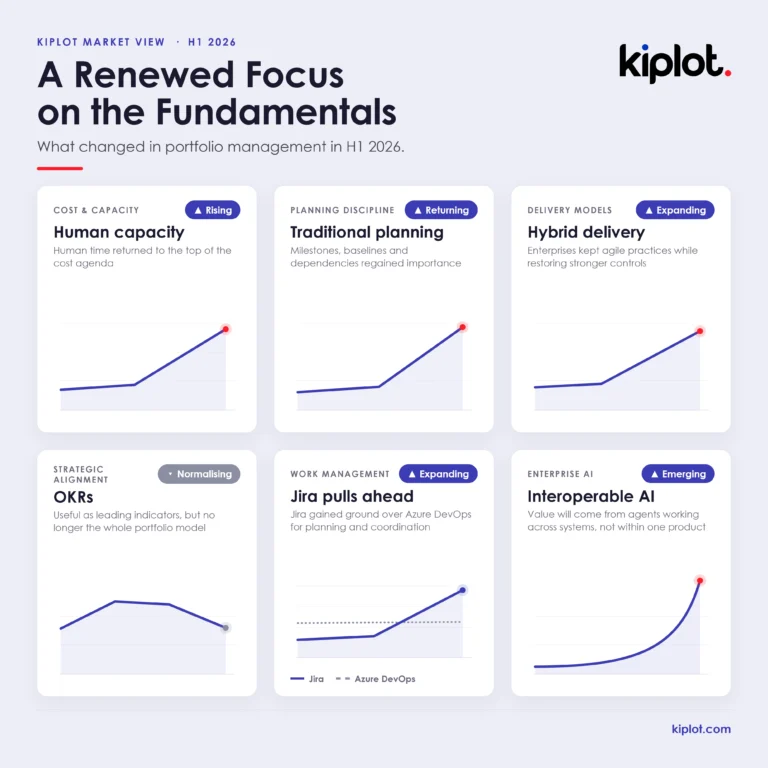 InsightsEnterprise Portfolio Management Trends: 2026 So FarAI dominated the conversation around enterprise portfolio management in the first half of 2026. But beneath the agentic fanfare, self-driving portfolios, synthetic PMOs, copilot-everything and the apparently imminent extinction of…
 AIFrom Plausible Risk Logs to Portfolio Assurance. What we learned building AI risk review for SPM teamsSPM teams don't need another way to fill a risk log. They need a better way to decide which risks deserve attention. What we learned building AI risk review.
 AIAgentic Project Management: How AI agents are changing portfolio delivery without removing human accountabilityMost AI in portfolio management is still reactive: it answers when asked. Agentic Project Management is what acting on its own looks like, and what that shift means for cost per benefit dollar.
 AIAI for the PMO: 8 Use Cases Transforming Portfolio ManagementAs portfolios scale, the PMO's administrative load expands with them. Eight use cases where AI shifts capacity from maintaining visibility to interpreting it.
 knowledgeArchitecting Jira for large organizationsJira's flexibility is also its risk. At scale, it tips into chaos without deliberate structure. How to architect Jira for consistency and data quality without crushing agility.