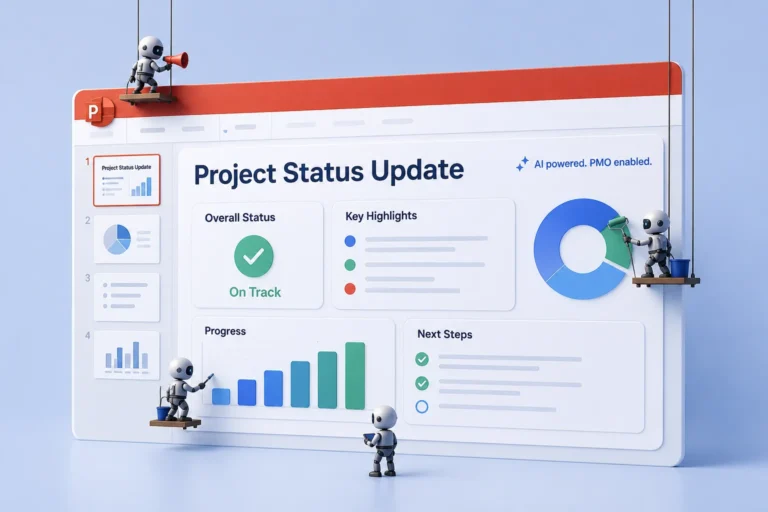
Agentic AI can already take on much of the traditional PMO workload: chasing updates, drafting reports, preparing packs and monitoring portfolio data.
That does not make the PMO redundant. It makes the administrative PMO redundant.
As AI makes enterprise work faster, the PMO’s value moves up the chain: protecting the truth in portfolio reporting, creating safe routes for experimentation, and helping leaders decide what deserves funding, capacity and attention.
We use cookies to enhance your browsing experience, serve personalised ads or content, and analyse our traffic. By clicking "Accept All", you consent to our use of cookies.
Preferences
Strictly Necessary
These cookies are essential for the website to function and cannot be switched off.
Functional
Enable enhanced functionality and personalisation, such as videos and live chats.
Analytics
Help us understand how visitors interact with the site by collecting anonymous information.
Marketing
Used to deliver advertisements more relevant to you and your interests.
Strategic Portfolio Management
The Enterprise Guide to Strategic Portfolio Management
A comprehensive guide to Strategic Portfolio Management: how organizations connect strategy to investment and capacity, make trade-offs across competing commitments, and adapt the portfolio as priorities, evidence and delivery conditions change.
Strategic Portfolio Management (SPM) is the management discipline for connecting strategic priorities to decisions about investment, capacity, governance and delivery across a portfolio.
It governs how an organization selects, funds, resources and oversees its portfolio in support of strategic objectives. Those priorities may be expressed through objectives, KPIs, OKRs, investment themes or business outcomes.
Strategic planning and portfolio execution usually operate at different levels of the organization. Executive management may approve a strategy and financial envelope, while business units submit investment proposals, Finance manages budgets, the EPMO coordinates the portfolio and delivery teams work through Jira, Azure DevOps or detailed project plans.
Strategic Portfolio Management connects those decisions. It gives the organization a current view of where investment and capacity are committed, how delivery is progressing, and where decisions need to change.
That remit extends beyond projects and does not require one delivery model. Stage-gated work, Agile delivery and product models can all sit within the same portfolio.
What sits within a strategic portfolio
A strategic portfolio is the set of initiatives, projects, programs, products, value streams and other investments governed together against shared strategic priorities and constraints.
There is no requirement for an organization to adopt one unit of work. Depending on the organization, the portfolio may contain:
strategic initiatives and transformation programs
projects and major change programs
products, product investments and value streams
technology platforms and infrastructure
regulatory and mandatory change
operational improvement
acquisitions, integrations or other material investments
A bank may manage regulatory programs alongside digital products and cost-reduction initiatives. An industrial organization may combine capital programs, technology modernization and product development. A public-sector portfolio may organize investment around programs and policy outcomes.
Organizations use different terminology for the work in the portfolio. Strategic Portfolio Management needs to accommodate those differences without forcing projects, programs, products and value streams into one model.
A strategic portfolio does not need to follow one hierarchy
The same investment may sit within several portfolio views at once.
A transformation initiative might support a strategic objective, belong to a business-unit portfolio, consume capacity from several shared business capabilities and depend on technology investments governed elsewhere.
Finance may need to view the portfolio by investment category or funding envelope. Strategy may assess the same investments against strategic priorities. The EPMO may need a cross-portfolio view of dependencies, milestones and capacity.
Each view should refer to the same underlying investment.
One initiative
Customer platform transformation
Funded once and governed once, but represented through five portfolio views.
Strategic objective
What the investment is expected to advance, and the contribution portfolio governance will test it against.
Business-unit portfolio
Where the initiative is owned, reported and prioritized against local commitments.
Funding envelope
Which capital or operating budget it draws on, and the ceiling it competes within.
Shared business capability
Which shared teams or skills the investment requires, and which other commitments depend on the same capacity.
Technology dependency
What it relies on that is planned and governed elsewhere in the portfolio.
Finance, Strategy and the EPMO each need a different view of the same investment. Portfolio management maintains those relationships without holding five separate versions of the portfolio.
The decisions Strategic Portfolio Management supports
Strategic Portfolio Management supports portfolio decisions throughout the life of an investment. Organizations need to compare proposed work with existing commitments and reassess funded initiatives when cost, capacity, dependencies, strategic priorities or expected benefits change.
In practical terms, portfolio management should answer recurring questions:
Which existing and proposed investments still justify funding?
Does the portfolio fit within available capital and capacity?
Which commitments cannot be delivered together because of shared constraints or dependencies?
Where has the investment case changed since approval?
What decision is required at the next portfolio review?
How portfolio management evolved toward Strategic Portfolio Management
Strategic Portfolio Management is an extension of earlier portfolio-management practices, not a replacement for them.
Project Portfolio Management established stronger portfolio control across projects. The spread of Agile delivery changed expectations around planning and adjustment. Strategic Portfolio Management places greater emphasis on connecting strategy, investment and outcomes within the same recurring portfolio process, while retaining disciplines developed through PPM and Agile portfolio practices.
Project Portfolio Management established portfolio control
Project Portfolio Management formalized the management of projects as portfolios, with common mechanisms for selection, governance and reporting across related work.
It gave organizations established approaches to business cases, budgets, resource allocation, schedules, dependencies and portfolio reporting. Those disciplines remain fundamental to Strategic Portfolio Management.
PPM also moved management attention above the success of an individual project. A project could meet its schedule and budget while the wider organization still committed too much capacity to lower-priority work. Portfolio management created the means to assess projects relative to one another.
The distinction is not that PPM manages delivery while strategy arrives later. Mature PPM has long included prioritization and strategic alignment. Strategic Portfolio Management places greater emphasis on making strategy, funding decisions and portfolio changes part of the same review cycle.
The growth of Agile delivery changed the environment in which many portfolios operated.
Technology and digital teams moved toward shorter delivery cycles and more frequent feedback. Fixed project plans increasingly sat alongside product backlogs, persistent teams, program increments and other Agile structures. Portfolio management had to accommodate work whose scope and sequencing changed more frequently than traditional project governance expected.
Agile Portfolio Management developed around that need. It strengthened practices such as shorter planning horizons, iterative investment decisions and greater autonomy at delivery level.
Those practices influenced wider portfolio management, particularly in technology-intensive organizations. They did not remove the need for annual budgets, financial controls, business cases, regulatory governance or fixed milestones elsewhere in the organization.
Strategic Portfolio Management places greater emphasis on strategic investment
Strategic Portfolio Management brings portfolio management closer to the decisions that allocate capital and capacity to strategic priorities.
It retains financial governance, portfolio control and structured decision rights. It also accommodates changes in priorities and delivery conditions within the planning year, providing a governed route for reconsidering investment as the evidence changes.
The central question becomes whether the current portfolio is still the best use of the organization's money and capacity. Delivery methodology remains relevant, but it does not define the portfolio.
PPM, Agile practices and strategic investment management can operate together. One portfolio may contain detailed project governance inherited from PPM, iterative planning practices associated with Agile and strategic investment decisions operating above both.
Project Portfolio ManagementPPMEstablished
Project selectionBusiness casesBudgets and forecastsResource allocationSchedules and dependenciesStage-gate governancePortfolio reporting
Agile Portfolio ManagementAgile practicesAdded
Shorter planning horizonsIterative investment decisionsPersistent teamsBacklogs and value streamsDelivery-level autonomy
Strategic Portfolio ManagementSPMGreater emphasis on
Strategy-to-investment traceabilityInvestment allocation across different types of workCapacity as a strategic constraintScenario trade-offsIn-year portfolio adaptationOutcome accountability
These disciplines can operate together in hybrid portfolios. Regulatory programs may retain stage-gates while digital products run on Agile cadences, with both governed through the same strategic investment process.
Each approach contributed disciplines that remain useful. The relevant question is which controls and planning methods apply to a given investment and which decisions need to be made at portfolio level.
How Strategic Portfolio Management works
Strategic Portfolio Management works through a recurring management cycle that provides a practical framework for portfolio decision-making. Strategy informs proposed investments; funding and capacity determine what can be committed; execution evidence then informs portfolio review and reprioritization.
The cycle continues after approval because the assumptions behind an investment can change during delivery.
The diagram below follows one illustrative example through that cycle: an organization entering annual planning with $400 million of proposed transformation investment against a $250 million funding envelope. The figures are constructed to show the mechanics of the decision.
Strategy sets the priorities
Strategic objectivesInvestment themesKPIs and OKRsBusiness outcomesFinancial targets
These establish the basis for portfolio decisions.
1IntakeShould this demand enter the portfolio for assessment?
Example$400 million of proposals arrives across regulatory programs, digital products, cloud migration, cost reduction and business-unit transformation.
2PrioritizationHow does it compare with what is already committed?
Example$280 million is rated high priority against the $250 million envelope, close enough to appear financially viable before capacity is tested.
3Funding and capacityCan the prioritized portfolio be funded and staffed?
ExampleShared data engineering and architecture teams cover only part of the first half of the year, and two major initiatives depend on a platform migration completing in Q2.
4ExecutionWhat is the current cost, confidence and outcome position?
ExampleThree months in, cost reduction is behind its benefits trajectory while one digital investment has a stronger commercial case than assumed during annual planning.
Portfolio review reconsiders the investment
Revise fundingMove capacityChange scope or timingResequence dependenciesPause or stop
Funding, capacity, scope, timing and sequencing can change as current financial, delivery and benefits evidence returns to the investment decision. In the example, the QBR reallocates capital and capacity without reopening the strategy or abandoning the approved budget.
The cycle is recurring. In this example, annual planning sets the envelope; the review cadence determines whether the current allocation of capital and capacity still holds.
Strategic priorities define the basis for portfolio decisions
Portfolio management supports strategic goals by making them part of how initiatives are prioritized, funded, resourced and reviewed.
Whatever terminology the organization uses, the relationship needs enough specificity to support an investment decision. Mapping every initiative to broad objectives such as growth or operational excellence provides little basis for comparison. Where OKRs are used, they become relevant when they influence investment decisions or provide evidence of whether funded initiatives are producing the intended outcome.
Strategic contribution is one factor alongside expected value, cost, risk, capacity and delivery constraints.
Portfolio intake establishes a common view of demand
New work enters the portfolio from multiple sources. Demand can come from business-unit proposals, technology investment, regulatory obligations, additional funding requests from existing programs and product roadmaps.
A portfolio intake process creates a governed route for assessing that demand.
This does not require every proposal to follow an identical business case. A regulatory initiative and a speculative growth investment have different investment rationales.
The organization does need enough common information to understand the investment, its expected outcome, funding requirement, capacity demand, dependencies and material risks.
Prioritization determines relative importance
Prioritization is comparative. Each initiative is assessed against the existing and proposed investments competing for the same funding and capacity.
Strategic contribution is one input. Expected benefits, cost, risk, urgency, dependency position and regulatory requirements may also affect the decision.
Scoring models structure the evidence rather than determine the decision. Similar scores can have very different implications for capital allocation or scarce specialist capacity.
Existing commitments also need to remain inside the comparison. A prioritization process that evaluates only new demand ignores the capital and capacity already committed to the portfolio.
Mandatory work requires explicit treatment. Regulatory or contractual commitments may offer limited discretion, but they still consume funding and capacity that cannot be allocated elsewhere.
For more detail on scoring criteria and portfolio-level prioritization, see portfolio prioritization.
Funding and capacity turn priorities into a viable portfolio
Priorities need to be tested against available funding and capacity before the portfolio is treated as committed.
The financial view should connect strategic priorities to the capital and operating expenditure committed to them. Strategic Portfolio Management can sit alongside annual plans, formal approvals and established finance controls while supporting additional investment decisions during the year.
Portfolio finance also needs to reconcile top-down funding envelopes with bottom-up forecasts. The organization may set an investment ceiling by business unit, strategic priority or portfolio while individual initiatives continue to update expected spend as delivery progresses.
Some organizations use more adaptive funding approaches, where investment can be released, increased or redirected as the evidence behind an initiative changes. This does not require annual budgeting or established financial controls to be removed. The financial planning cycle and the portfolio decision cadence can operate at different frequencies.
The financial criteria used to compare investments should also reflect the type of decision being made. Capital investments may use measures such as NPV, IRR or payback period alongside strategic criteria. Regulatory, risk and mandatory investments require different evidence because the same financial return model does not capture their rationale.
Funding is only one constraint. The organization also needs to test the proposed investments against the teams, roles or skills required to deliver them. Resource capacity planning belongs in strategic portfolio planning when the portfolio is being agreed.
A portfolio can fit within its approved budget and still depend on more specialist capacity than is available. Detailed individual allocation may remain useful in some project environments, while product and Agile organizations may plan around persistent teams. Strategic Portfolio Management needs a credible view of whether the funded portfolio is staffable without imposing one resource-planning method across every team.
Scenario planning tests portfolio choices before commitment
Scenario planning evaluates the consequences of alternative portfolio decisions before they are committed.
Scenario planning can compare the effect of delaying an initiative, increasing funding, moving a dependency, changing a target date or reallocating a constrained team.
The purpose is to understand the consequences of each plausible choice using current financial, capacity and dependency data. Scenario planning is particularly useful during annual planning and material reprioritization, or whenever several credible options compete for the same constraints.
Strategic roadmapping connects decisions across planning horizons
Strategic roadmapping sets out how major investments, dependencies and strategic milestones are expected to develop across planning horizons.
It operates above the detailed schedules maintained by individual delivery teams. Portfolio governance needs visibility into when major investments are expected to start, what they depend on and where commitments compete for the same timing or capacity.
Roadmaps also connect decisions made at different horizons. An annual investment decision may establish the direction of the portfolio, while quarterly reviews adjust sequencing as funding, capacity or dependencies change.
The roadmap should reflect the current portfolio decision and remain distinct from the detailed delivery plans maintained by individual teams.
Portfolio risk and dependencies need a cross-portfolio view
Portfolio risk management looks beyond the risks attached to individual initiatives and assesses exposure across the portfolio.
Several investments may depend on the same supplier, technology platform, regulatory milestone or constrained team. Each initiative may carry an acceptable risk profile in isolation while their combined exposure creates a material concern at portfolio level.
Dependencies require the same cross-portfolio view. A project manager may manage dependencies within an individual plan, while portfolio governance needs to identify constraints that affect several investments, shared teams or strategic milestones.
Risk and dependency exposure should inform prioritization, sequencing, scenarios and portfolio reviews.
Execution provides evidence for portfolio governance
Once initiatives move into delivery, the portfolio needs current evidence on financial performance, milestones, dependencies, risks, capacity and expected outcomes.
That does not require the portfolio office to reproduce the delivery plan. Project managers may work in detailed schedules, Agile teams in Jira, product teams in roadmaps and Finance in an ERP system.
Portfolio management takes the information needed for portfolio decisions from those systems and presents it at the level the governance forum requires.
Delivery evidence should stay distinct from investment value. An initiative may complete its planned scope but fail to deliver the expected reduction in operating cost. Another may miss an intermediate milestone while remaining strategically important enough to justify continued investment.
Portfolio reviews reconsider the investment case
Portfolio reviews assess whether the assumptions behind previous decisions still hold.
A review should go beyond RAG status and milestone commentary. The review needs to establish where forecast cost has changed, whether capacity remains sufficient, which dependencies affect sequencing and whether expected benefits still justify continued investment.
Portfolio governance needs both leading and lagging evidence. Capacity constraints, dependency exposure and forecast variance can indicate where intervention is required before the eventual outcome is known. Realized benefits and financial outcomes establish what the investment ultimately produced.
Portfolio reporting should correspond to the decision being made. A CFO reviewing forecast spend needs different evidence from an EPMO reviewing dependency exposure, while a QBR focused on strategic priorities requires a different view from a weekly delivery review.
That evidence allows leaders to revise funding, move capacity, change scope or timing, resequence dependencies or pause work when the investment case has changed materially.
Benefits need an owner, baseline, target and agreed method of measurement. Where benefits accrue after delivery, accountability needs to continue beyond project closure. Benefits realization provides the link between the approved investment case and the outcome ultimately achieved.
Strategic Portfolio Management vs Project Portfolio Management
Strategic Portfolio Management does not replace the core disciplines of Project Portfolio Management. It broadens the management scope and places greater emphasis on strategic investment, capacity allocation and how the portfolio changes over time.
PPM remains an accurate description of the management discipline in many organizations. Organizations do not need to rename projects as initiatives or replace established governance terminology to practice Strategic Portfolio Management.
The difference is primarily one of scope and management emphasis.
Dimension
Project Portfolio Management
Strategic Portfolio Management
Primary management question
How should projects and programs be selected, prioritized and governed as a portfolio?
How should investment and capacity be allocated across strategic commitments, and adjusted as conditions change?
Typical scope
Projects and programs
Initiatives, projects, programs, products, value streams and other material investments
Strategic linkage
Projects are selected and prioritized against business objectives
Strategic priorities directly inform recurring investment and portfolio decisions
Financial focus
Project and portfolio budgets, actuals and forecasts
Investment allocation alongside portfolio financial control
Capacity
Resources planned and allocated across projects
Capacity considered as a constraint on strategic portfolio commitments
Governance
Project lifecycle and portfolio controls
Investment governance alongside delivery and outcome governance
Review focus
Portfolio health, delivery performance and project controls
Portfolio performance, strategic contribution and potential reallocation
Delivery model
Can govern projects and programs delivered through waterfall, Agile or hybrid methods
Extends governance across projects, products, value streams and other investment types without requiring one delivery method
An organization with strong PPM does not need to discard that foundation. Strategic Portfolio Management makes strategic priorities, portfolio investment and outcome evidence more influential within governance mechanisms that may already exist.
How Strategic Portfolio Management relates to EPPM, Agile Portfolio Management and project management
Portfolio terminology is not standardized across the market.
Two organizations with similar portfolio-management practices may describe them as Strategic Portfolio Management and EPPM. Another may retain PPM while practicing many of the same disciplines. The useful distinction is the management scope behind the label.
Strategic Portfolio Management and Enterprise Project Portfolio Management
Enterprise Project Portfolio Management, or EPPM, applies portfolio-management disciplines across a broad project environment.
It commonly covers portfolio governance, project selection, capacity, financials, dependencies and reporting across business units or major portfolios.
The two overlap substantially. Strategic Portfolio Management places greater emphasis on strategic investment decisions and on portfolios that may contain more than projects.
For an organization with a mature EPPM function, adopting these principles can be an expansion of scope within existing portfolio governance.
Strategic Portfolio Management and Agile Portfolio Management
Agile Portfolio Management applies portfolio thinking to environments using Agile delivery.
It addresses issues such as prioritization across backlogs or value streams, capacity at team level, shorter planning cycles and funding models that accommodate iterative delivery.
Strategic Portfolio Management has a broader remit. One portfolio may contain Agile products alongside fixed-scope regulatory programs, infrastructure projects and stage-gated investments. Portfolio governance needs comparable information across those environments without requiring them to use the same delivery methods.
Strategic Portfolio Management and project management
Project management governs the planning and delivery of an individual project. Portfolio management governs decisions across the portfolio in which that project sits.
A project manager needs detailed control of scope, milestones, risks, budget and dependencies. Portfolio governance needs enough of that information to decide whether the project remains a justified commitment relative to the rest of the portfolio.
The disciplines operate at different management levels.
Strategic Portfolio Management across hybrid delivery models
Strategic Portfolio Management governs hybrid portfolios through common portfolio information and decision rights while delivery teams retain different delivery methods.
A single organization may run Agile products, stage-gated programs and fixed-scope regulatory work at the same time. A technology function may use Agile teams and product funding, a regulatory program may have fixed deadlines and formal stage-gates, a transformation office may govern major initiatives through quarterly business cases, and infrastructure work may use detailed project schedules and capex controls.
Forcing those environments into one delivery method creates unnecessary friction.
Portfolio management standardizes the information and decision rights required for governance across the organization without standardizing the mechanics of delivery. The organization needs consistent answers to portfolio-level questions covering strategic contribution, funding, forecast cost, capacity, major dependencies, delivery confidence and expected benefits.
That does not require every initiative to use the same milestones, backlog structure or resource model.
Where delivery teams work in specialist systems, portfolio governance should draw from those systems rather than recreate the underlying plans. Jira and Azure DevOps can remain the systems where teams manage delivery while portfolio governance operates above them.
Ownership and decision rights in Strategic Portfolio Management
Strategic Portfolio Management ownership is distributed across executive management, Strategy, Finance, accountable business leaders and the PMO or EPMO.
Role
Responsibility in Strategic Portfolio Management
Executive management
Sets strategic priorities and approves material investment decisions.
Strategy, where a central function exists
Maintains the strategic priorities and planning assumptions against which portfolio choices are assessed.
Finance
Maintains financial controls, funding assumptions and the financial evidence used in investment decisions.
PMO / EPMO
Operates the portfolio process, maintains the portfolio view, manages intake and prioritization, and prepares investment trade-offs for governance forums.
Business leaders
Own investment cases and remain accountable for the business outcomes expected from funded initiatives.
Delivery management
Owns execution within the funding, capacity, governance and delivery constraints agreed at portfolio level.
These responsibilities do not give one function unilateral authority over the portfolio. Decision rights should define which forum or role has authority to:
approve new investment
change funding or scope beyond agreed tolerances
resolve competition for constrained capacity
accept material portfolio risk
defer, pause or stop an initiative
approve changes to strategic priorities or portfolio constraints
Authority may sit across executive committees, investment committees, portfolio boards, Finance and business leadership. A portfolio board may approve changes within an agreed financial tolerance, a larger funding decision may require CFO or executive committee approval, and a program steerco may manage delivery issues that have no material effect on the wider portfolio.
A more frequent review cadence creates more opportunities to reconsider portfolio choices, so governance needs to preserve accountability as those decisions change.
Benefits of Strategic Portfolio Management
The benefits of Strategic Portfolio Management come from improving the quality and timing of portfolio decisions.
They should not be measured by the introduction of a new framework or by the volume of reporting the portfolio office produces.
Investment decisions use comparable evidence
Portfolio management establishes common information for comparing existing and proposed investments, allowing the organization to assess strategic contribution alongside cost, capacity, risk, dependencies and expected outcomes using a current portfolio view.
Business cases produced at different points in time are difficult to compare unless their financial assumptions, strategic criteria and current forecasts are normalized.
Portfolio commitments reflect delivery capacity
Connecting capacity planning to investment decisions exposes situations where approved work depends on more capacity than key teams can provide, so sequencing, demand or capacity can be adjusted before those constraints turn into delivery variance.
Portfolio intervention happens earlier
Dependencies, forecast changes and capacity constraints become visible across the portfolio, giving governance forums more opportunity to intervene while credible choices remain around scope, timing, funding or sequencing.
Financial governance remains connected to delivery
Bringing approved funding, forecast spend and delivery evidence into the same portfolio review allows Finance to retain its formal controls while portfolio leaders assess whether changes in cost correspond with changes in delivery confidence or expected value.
Reprioritization becomes a governed management activity
Strategic priorities can change within the planning year. Portfolio management provides an established route for reconsidering investments as new regulatory obligations emerge, assumptions behind a business case change or constrained capacity needs to move toward a more important initiative.
Outcome accountability extends beyond delivery
Keeping expected benefits connected to the investment after approval allows the organization to distinguish between completing the agreed work and producing the result used to justify the expenditure, including benefits that materialize after delivery has finished.
Governance and decision-making in Strategic Portfolio Management
Portfolio governance defines how decisions are made, which information is required and how frequently the portfolio is reconsidered.
Those decision rights need to be translated into proportionate controls, review forums, evidence requirements and escalation thresholds.
Portfolio governance
Governance should match the significance of the decision. A major acquisition integration, regulatory program and small operational improvement should not require identical controls.
Common governance does not mean identical controls. It means clear rules for deciding which controls apply. This keeps portfolio oversight proportionate while preserving the evidence required for material investment decisions.
Planning and review cadence
Annual strategy and budgeting can sit alongside more frequent portfolio reviews.
The appropriate cadence depends on the decisions being made. A typical pattern might include:
Cadence
Typical portfolio decisions
Annual planning
Set investment envelopes, confirm major commitments and translate strategic priorities into portfolio choices.
Monthly portfolio review
Review forecast movement, delivery confidence, dependencies and material capacity constraints.
Quarterly review / QBR
Reassess strategic alignment, expected outcomes, major investment choices and portfolio-level reprioritization.
Event-driven review
Respond to material changes such as a new regulatory obligation, significant forecast movement, a critical dependency change or a new strategic priority.
These are representative cadences, not a prescribed model. Governance forums should meet when the decisions they own require current portfolio evidence.
Common portfolio information
Portfolio governance needs a defined set of common information.
At initiative level, that typically includes an owner, strategic relationship, lifecycle status, financial position, material milestones, capacity requirement, dependencies, risks and expected outcomes. The precise fields should reflect how the portfolio is governed.
Requiring information that no portfolio decision uses adds administration without improving control. Omitting decision-critical information leaves governance forums dependent on manual reconciliation when the issue reaches steerco.
Escalation and exceptions
Portfolio governance should define tolerances within which initiative teams retain authority.
A project manager should not require portfolio approval for every schedule adjustment. A material change to forecast cost, strategic outcome or a dependency affecting several initiatives may require escalation.
This preserves local accountability while protecting portfolio-level commitments.
Implementing Strategic Portfolio Management
Implementation should begin with the portfolio decisions the organization needs to improve.
Starting with an exhaustive data model, new terminology or a large software rollout creates work before the management problem has been defined.
Start with the decisions that lack reliable evidence
Identify the portfolio decisions that cannot currently be made with reliable evidence.
The issue may be inconsistent prioritization, overcommitment of specialist capacity, poor forecast visibility, disconnected benefits reporting or an inability to assess the effect of new demand.
A new prioritization method has limited effect if funding and capacity remain committed regardless of the resulting priority. The implementation should begin with the decision and work back to the governance, information and process changes required to support it.
Establish the current portfolio
Establish what is already funded and underway before redesigning portfolio processes.
The initial view needs enough information to understand current investment, expected outcomes, delivery status and material capacity commitments.
The first portfolio view does not require uniform data quality. Establish a sufficiently reliable baseline for the portfolio decisions the organization needs to make, then improve the fields whose quality materially affects those decisions.
Define governance and decision rights
Document how investments enter the portfolio, how they are assessed, who approves them and which changes require further approval.
Existing governance should be retained where it remains useful. A mature finance approval process or regulatory stage-gate does not need replacement simply because the portfolio discipline is being introduced.
Implementation should concentrate on gaps between existing processes and the decisions the portfolio now needs to support.
Define the minimum common portfolio data
Use the governance requirements above to define the minimum fields the portfolio needs, then establish which system owns each type of information.
Do not create additional fields or duplicate plans unless a portfolio decision requires them.
Connect delivery and financial systems
Portfolio information should be taken from the systems where the underlying work and transactions are managed wherever practical.
Delivery data may come from Jira, Azure DevOps or project-management tooling, actual spend from ERP or finance systems, and other portfolio information may be managed directly through the portfolio process.
Integration reduces reconciliation and makes ownership clearer.
Establish a portfolio review cadence
Translate the agreed cadence into decision-led agendas. Each review should focus on changes requiring portfolio attention, including new demand, material forecast movement, capacity constraints, dependency exposure, strategic changes and evidence that expected benefits are no longer credible.
Routine reporting can sit beneath that decision process.
Add advanced practices once the underlying data is reliable
Scenario planning requires credible cost and capacity data. More sophisticated benefits management depends on clear ownership and baselines.
AI can reduce the manual work required to synthesize portfolio updates, identify patterns across risks and dependencies, and support scenario analysis. It does not change decision rights or remove the need for reliable financial, capacity and delivery data.
Common mistakes when implementing Strategic Portfolio Management
Common mistake
What happens in practice
Starting with data fields and taxonomy rather than decisions
Teams are asked to populate new fields, classifications and reports before the organization has defined which portfolio decisions the information needs to support. Administration increases without materially improving prioritization, funding or governance.
Prioritizing new demand without reassessing existing commitments
New proposals are scored and ranked, but most funding and capacity remain committed to work approved earlier. The organization improves intake while leaving the largest portfolio trade-offs untouched.
Approving investment without testing delivery capacity
The portfolio fits within the available budget but depends on more specialist capacity than the organization can provide. The constraint appears later as delivery delay, resource contention or repeated reprioritization.
Using one governance or delivery method across the whole portfolio
Projects, products, regulatory programs and Agile teams are forced into the same planning and reporting structure. Portfolio consistency is achieved by adding delivery overhead rather than by standardizing the information portfolio governance actually needs.
Increasing portfolio reporting without defining decision rights
More information reaches the PMO, steerco or portfolio board, but it remains unclear who can change funding, move capacity, alter scope or stop an investment. Governance becomes a reporting cadence rather than a decision process.
Judging investments primarily through delivery status
An initiative can remain green against schedule and milestones even when its forecast cost, strategic relevance or expected benefits have changed materially. Delivery performance becomes a substitute for reassessing the investment case.
When dedicated Strategic Portfolio Management software becomes valuable
Strategic Portfolio Management itself remains a management discipline. Smaller or less complex portfolios can operate with established governance processes and relatively simple tooling.
The case for dedicated Strategic Portfolio Management software becomes stronger when existing processes and systems no longer provide a reliable portfolio view. Common indicators include:
several portfolios competing for shared investment or capacity
material capex and opex governance across initiatives
mixed project, product and Agile delivery environments
executive reporting assembled manually from multiple systems
cross-portfolio dependencies affecting major commitments
repeated reprioritization during the planning year
significant differences between approved plans, financial forecasts and delivery data
A Strategic Portfolio Management platform should support the organization's governance, planning and delivery methods without requiring it to adopt the vendor's terminology or delivery methodology.
Core requirements include strategy-to-investment traceability, intake and prioritization, portfolio financial management, capacity planning, scenario analysis, governance, outcome tracking and integration with delivery and financial systems.
Configuration also matters. Portfolio structures and governance requirements change as business units are reorganized and new investment types enter scope. Routine changes to workflows, fields, views and governance rules should not require a major implementation cycle.
Principles of effective Strategic Portfolio Management
The principles of Strategic Portfolio Management concern how portfolio decisions are made, not the individual processes used to manage the portfolio.
Strategic priorities need to influence investment decisions, and funded commitments need to be tested against available capacity. Portfolio decisions need current financial, delivery and outcome evidence. Prior approval should not prevent an investment from being reassessed when its cost, expected benefit or strategic relevance changes materially.
Governance also needs clear authority over portfolio-level decisions while preserving appropriate autonomy for accountable business and delivery teams.
The end state is a portfolio where current strategic priorities, financial evidence, capacity and delivery performance continue to shape investment decisions after approval.