We use cookies to enhance your browsing experience, serve personalised ads or content, and analyse our traffic. By clicking "Accept All", you consent to our use of cookies.
Preferences
Strictly Necessary
These cookies are essential for the website to function and cannot be switched off.
Functional
Enable enhanced functionality and personalisation, such as videos and live chats.
Analytics
Help us understand how visitors interact with the site by collecting anonymous information.
Marketing
Used to deliver advertisements more relevant to you and your interests.
PMO Software
How to Choose Enterprise PMO Software
PMO software can describe anything from project and work-management tools to enterprise PPM and SPM platforms. This buyer's guide explains the differences and sets out what an enterprise PMO should assess before selecting a platform.
PMO software is software used by a Project Management Office, Program Management Office, Portfolio Management Office, or Enterprise PMO to manage the work and decisions within its remit.
The term overlaps with Project Portfolio Management (PPM) and Strategic Portfolio Management (SPM), but the three terms are not identical.
PPM established the disciplines required to manage projects and programs as a portfolio, including demand, resources, financials, dependencies, governance, and portfolio reporting.
SPM is an evolution of PPM. It retains those portfolio-management disciplines and connects them more directly to strategy, enterprise investment decisions, and outcomes. The focus moves beyond governing the delivery of approved work to governing the investment choices that shape the portfolio.
An organization may still search for PPM software while expecting strategic alignment, scenario planning, cross-portfolio capacity, and benefits. Another may use PMO software to describe the same enterprise requirement. The software evaluation should therefore focus on the responsibilities the platform needs to support.
Term
How it is commonly used
PMO software
Broad term for software used by a PMO to manage project or portfolio responsibilities
PPM software
Software for managing projects and programs across a portfolio
SPM software
An evolution of PPM that connects portfolio management with strategy, investment, capacity, and outcomes
EPMO software
Buyer terminology for software supporting the wider responsibilities of an Enterprise PMO
Project and work-management software
Software for planning and managing team or project execution. These capabilities may sit in a standalone work-management tool or within a broader PPM or SPM platform.
Scope of what is governed
Adjacent category
Project & work management
Team and project execution
TasksPlansWorkflowCollaboration
Different in kind
PMO software (buyer terminology)
SPM · Strategic Portfolio Management
The same disciplines connected more directly to strategy and enterprise investment decisions
A PMO focused only on coordination may be served by work management, while an enterprise PMO evaluating "PMO software" is usually assessing the PPM or SPM platform.
Project and work-management software
Task and work management is a common part of the enterprise delivery environment. It may be provided by standalone tools such as Asana, monday.com, Microsoft Planner, or Jira, or as part of a broader PPM or SPM platform.
These capabilities manage the work required to deliver projects and initiatives: tasks, plans, workflows, collaboration, and delivery reporting.
For the PMO, the requirement depends on what needs to happen above that delivery layer. Portfolio responsibilities can include assessing new demand against existing commitments, comparing funding and capacity, managing investment decisions, governing material changes, and maintaining the evidence used in portfolio reviews.
A platform can therefore provide task management and still extend substantially beyond work management. The relevant distinction is whether the software also supports the portfolio processes and decisions within the PMO remit.
Organizations do not need to manage detailed delivery in the portfolio platform simply because the capability exists. Teams can continue working in Jira, Azure DevOps, or another established delivery system while the PMO uses the portfolio platform for planning, reporting, and governance.
Core PMO software capabilities
Enterprise PMO software needs to support the portfolio processes that sit above individual project and team delivery.
The required depth varies by organization, but the main areas are consistent across most enterprise evaluations.
Requirement
What the software needs to cover
Portfolio visibility
A current view across initiatives, projects, programs, products, and other work in scope, including delivery status, dependencies, risk, financial position, and ownership
Demand and prioritization
Capture proposed work, develop and assess business cases, compare priorities, and govern approval into the portfolio
Financial and capacity planning
Maintain funding and forecasts, incorporate actuals, and compare portfolio demand with the teams, roles, skills, or individuals available to deliver it
Roadmaps and dependencies
Show how initiatives and major commitments are sequenced over time, including milestones, dependencies, timing constraints, and the effect of proposed changes
Portfolio scenarios
Test the effect of adding, delaying, stopping, or changing work before portfolio commitments are approved
Governance
Manage lifecycle stages, approvals, decision rights, tolerances, conditions, exceptions, and decision history
Benefits and outcomes
Retain the expected outcomes behind approved investment and track whether those expectations change over time
Portfolio reporting
Provide steerco, MBR, QBR, investment committees, and other governance forums with the evidence required for portfolio decisions
The depth required in each area depends on the responsibilities of the PMO. A function responsible primarily for assurance and reporting will use these capabilities differently from one that also manages demand, investment planning, capacity, and portfolio governance.
The distinction is particularly important when comparing work-management tools with enterprise PPM and SPM platforms. A project-management product may provide strong scheduling, workflow, and reporting without supporting portfolio financials, scenario planning, capacity constraints, or formal investment governance in the same depth.
The software also needs to accommodate the types of work the organization governs. Projects may sit alongside programs, products, transformation initiatives, regulatory work, and other investment. Those work types do not need identical delivery processes, but the PMO still needs comparable portfolio information where they compete for funding or capacity, or where leadership reviews them together.
Financial and capacity requirements deserve particular scrutiny because simple feature labels conceal substantial differences between products. Portfolio financial management may range from recording a project budget to managing approved funding, forecasts, actuals, capex and opex, and changes against the original business case. Capacity planning may range from named-person allocation within a project to forward planning across persistent teams, roles, and scarce skills.
Governance has the same variation. Some products provide workflow approvals. Enterprise portfolio governance may also require delegated authority, conditional approvals, tolerances, escalation, and a record of the decisions made through steerco, investment committees, or other portfolio forums.
Portfolio reporting should use the same underlying evidence. A change to forecast, delivery confidence, dependency, or expected benefit should be visible at the level where leadership reviews the portfolio without requiring the PMO to recreate the position separately for each reporting cycle.
Defining the requirements for the PMO
The PMO title alone provides little guidance on software requirements.
In one organization, the PMO may concentrate on project assurance, reporting, standards, and governance. In another, the same function may also manage portfolio demand, investment planning, financials, capacity, and benefits.
The software evaluation should reflect those responsibilities rather than assume a standard PMO structure.
Five areas need to be clear before the shortlist is fixed.
Area
What needs to be established
Scope
Which portfolios, business units, work types, and materiality thresholds are included
Responsibilities
Which processes the PMO manages, prepares, challenges, records, or governs
Decision rights
Which decisions sit with the PMO and which remain with sponsors, finance, steerco, investment committees, or other forums
Existing systems
Which delivery, finance, workforce, service, and reporting systems remain in place
Planned responsibilities
Which additional responsibilities have already been agreed for the PMO
Agreed future PMO responsibilities belong in the evaluation even if the function has not yet assumed them.
A PMO may currently produce consolidated portfolio reporting while the organization has already decided that demand management and quarterly portfolio planning will move into the function. Those requirements belong in the evaluation because the change has already been agreed.
That is different from buying functionality against an undefined future need.
The implementation sequence can still reflect the organization's readiness. Common reporting structures may need to be established before more detailed financial or capacity planning is introduced. The product selection should still account for responsibilities that are already expected to sit with the PMO.
Requirements need operating context
Feature names alone rarely provide enough information for an enterprise comparison.
"Resource capacity planning" could describe named-person allocation within individual projects or forward planning across teams and scarce skills. Those are materially different requirements.
A better requirement states the decision the organization needs to support.
For example:
The PMO needs to compare proposed investment with the capacity of persistent teams and scarce specialist roles before quarterly commitments are approved.
The requirement now establishes the planning level, the portfolio context, and the decision being made.
"Portfolio financial management" should state whether the PMO needs budget tracking, forecasts, actuals, capex and opex, funding decisions, or changes against an approved business case.
"Portfolio reporting" should identify which forums use the information and which decisions those forums make.
"Governance" should identify the approvals, tolerances, conditions, and escalation routes that the software needs to control.
Specific requirements give shortlisted vendors less scope to demonstrate a superficially similar feature that addresses a different problem.
PMO software within the enterprise technology stack
Enterprise organizations already have systems that own detailed delivery, finance, workforce, service, and reporting information.
The portfolio platform needs to use that information without creating unnecessary duplicate records.
System type
Typical responsibility
Jira, Azure DevOps, and work-management tools
Detailed team and delivery work
ERP and finance systems
Actuals, accounting records, rates, and financial controls
HR and workforce systems
People, organizational, role, and workforce records
ITSM platforms
Service, operational, incident, and change information
BI platforms
Enterprise analysis and reporting where required
Portfolio platform
Portfolio planning, governance, investment evidence, and decision records
The exact boundaries vary, but ownership of material information should be explicit.
If finance owns actual cost, the portfolio platform should use those actuals rather than maintain a competing accounting record. If Jira owns detailed engineering work, delivery teams should not have to maintain the same backlog in another platform.
The PMO needs the information required for portfolio governance at the level at which the decision is made.
A portfolio review does not need every backlog item from a delivery tool. It may need the current milestone position, delivery confidence, a material dependency, and the forecast effect of a delay.
The same principle applies to finance. Portfolio governance needs current financial evidence without reproducing the ERP controls used to produce it.
A technical connection to Jira, Azure DevOps, ERP, or another enterprise system does not establish whether the integration meets the PMO requirement.
The evaluation should identify which records and fields move between systems, which system owns each field, and the direction of synchronization.
The design also needs to account for the enterprise environment.
An organization may operate several Jira instances, use different field structures across business units, or receive financial actuals on a controlled schedule. The integration needs to accommodate those conditions without making the portfolio record ambiguous.
Data currency matters when leadership uses the information in governance. Before a portfolio review, the PMO needs to know whether financial, delivery, and capacity information refers to the expected reporting period.
Synchronization failures should be visible to the teams responsible for the portfolio record. A source that stopped synchronizing should not continue to present stale information as current.
The evaluation should also establish who maintains field mappings and how changes to source-system fields or structures are handled.
These questions determine whether an integration supports a portfolio process rather than simply exchanging data.
Enterprise requirements beyond core functionality
A prepared demonstration can make several enterprise platforms appear functionally similar.
The differences become clearer when the evaluation considers how the organization will configure, control, implement, and maintain the product.
Configuration and administration
Portfolio structures, governance, reporting, and planning processes change after implementation.
The organization should establish which changes the internal team can make through supported configuration.
Relevant areas include terminology, portfolio hierarchy, work types, forms, fields, lifecycle stages, approval rules, prioritization methods, financial structures, permissions, reports, and integration mappings.
The evaluation should separate supported configuration from custom development.
Configuration uses controls maintained within the standard product. Custom development introduces implementation-specific code or extensions.
Custom development may be justified for a specific requirement, but the associated maintenance and upgrade implications need to be understood before selection.
The same applies to specialist administration.
A platform may support a governance change while requiring a specialist administrator, vendor consultant, or implementation partner to make it. The evaluation should make that dependency visible.
A vendor session should include a meaningful configuration change rather than only a demonstration of a prepared environment.
Security and enterprise controls
PMO software can contain sensitive information about investment, strategy, financial exposure, delivery performance, capacity, risk, and future commitments.
The evaluation should cover identity and SSO, access controls, privileged administration, audit history, encryption, retention, data handling, environment management, data residency where relevant, and the assurance required by internal policy.
Permissions need to reflect the organization's decision rights.
An initiative owner may maintain delivery evidence without authority to change funding. A portfolio administrator may control one portfolio without access to commercially sensitive work elsewhere. An executive may require broad visibility without administrative rights.
Audit requirements extend beyond system access. Changes to approvals, financial forecasts, lifecycle status, benefit assumptions, and decision records may require attribution where they affect governance.
Integrations need comparable controls around credentials, service accounts, access, and data movement.
AI
AI now belongs in enterprise PMO software evaluation because vendors increasingly use it to analyze portfolio evidence, prepare information, make recommendations, and automate administrative work.
The first question is what work the AI performs.
Relevant uses include preparing status information, checking business-case evidence, identifying inconsistent forecasts, surfacing changes in risk or dependencies, supporting scenario analysis, and preparing recommendations for portfolio review.
Agentic capability requires an additional control question because reading information is different from changing it.
An AI system may prepare a draft, recommend an action, update a record, trigger a workflow, or take an action within defined limits. The organization needs to understand the authority associated with each activity.
AI findings should remain traceable to the portfolio evidence behind them.
If AI identifies a capacity constraint, the relevant teams, roles, planning periods, and commitments should remain available for inspection. A financial recommendation should be traceable to the current forecast and actuals.
Portfolio evidence can conflict when systems update at different times. The AI should identify material uncertainty where the available evidence does not support a definitive conclusion.
Existing access controls should apply through the AI interface. A user without access to a restricted portfolio should not receive information from that portfolio through AI.
Where AI changes a record or triggers an action, the history should retain what happened and under which authority. Human approval should remain explicit where governance requires it.
The evaluation should also cover model and provider controls, enterprise data handling, retention, and the treatment of sensitive portfolio information.
Implementation, administration, and total cost
Implementation scope should follow the portfolio process the organization intends to establish.
Data migration is one example. Historic project records may contain stale information, inconsistent definitions, duplicate fields, or financial data based on different reporting periods. Migration should focus on the information required for the future portfolio process.
Integration design should follow agreed data ownership. Training should reflect the responsibilities of portfolio administrators, project and initiative owners, sponsors, and executive users.
The organization should also establish which responsibilities remain internal after implementation and which continue to depend on the vendor or an implementation partner.
Routine administration, configuration changes, integration maintenance, reporting changes, support, and upgrades contribute to the ongoing cost.
The commercial assessment should extend beyond subscription price. Implementation, migration, integrations, specialist services, training, administration, support, additional environments, and planned expansion belong in the comparison.
Pricing should reflect the intended deployment rather than a narrow initial scope.
A useful vendor comparison asks shortlisted suppliers to respond to the same requirements and prove the result against the same portfolio situations.
This reduces the influence of prepared product demonstrations and makes differences in configuration, integration, governance, and administrative dependency easier to see.
PMO software vendor evaluation
Evaluation area
What to establish
What the vendor should prove
Portfolio coverage
The platform represents the portfolios, work types, structures, and terminology within scope
Configure a representative structure using the organization's terminology
Portfolio decisions
Proposed and approved work can be assessed using current funding, capacity, dependencies, and priorities
Add new demand and show the effect on current commitments
Financials and capacity
The PMO can assess whether commitments remain affordable and executable
Change a forecast or capacity assumption and show the resulting portfolio position
Governance
Decision rights, conditions, tolerances, exceptions, and approvals are controlled and recorded
Run a material change through the required governance process
Reporting and evidence
Leadership can inspect the evidence supporting portfolio status and decisions
Trace a material portfolio change to its underlying source
Enterprise architecture
Existing delivery, finance, workforce, service, and reporting systems retain appropriate ownership
Demonstrate realistic data flows and identify the authoritative source for material information
Product architecture
The required capabilities operate coherently across portfolio data, permissions, configuration, workflow, and reporting
Move one portfolio record through several required processes and show where product, module, or data boundaries occur
Configuration
The internal team can maintain agreed processes at an acceptable level of dependency
Change a lifecycle, approval rule, field, hierarchy, or report during the session
Security and controls
The product meets enterprise identity, access, audit, and data requirements
Demonstrate the relevant controls and provide supporting assurance evidence
Scale and resilience
The platform performs at the organization's portfolio and user volumes, with the availability, recovery, and operational support the deployment requires
Establish performance at representative portfolio and user volumes, service availability, backup and recovery arrangements, and operational support and escalation
AI
AI performs useful PMO work against governed evidence and within defined authority
Show the source evidence, permissions, and actions available for an AI finding
Implementation and administration
The organization understands what requires configuration, services, custom work, or specialist support
Separate the standard product from implementation-specific work
Commercial model
The expected deployment can be costed beyond the subscription
Price the intended users, integrations, services, support, environments, and planned expansion
The organization should weight these criteria according to its own responsibilities and selection priorities.
The weighting can differ without changing the evidence requested from each vendor.
Common scenarios for vendor demonstrations
The scenarios below provide a starting point. Enterprise buyers should replace them with examples from their own portfolio where practical.
Scenario
Ask the vendor to show
What it tests
Mandatory work enters a constrained portfolio
Add the new work and show the effect on current commitments
Prioritization, capacity, scenarios, governance
Forecast cost rises and expected benefit moves later
Update the investment and show the effect on the portfolio position and approval
Show the finding, underlying evidence, recommendation, and permitted actions
AI grounding, permissions, human authority, audit
Red flags during vendor evaluation
A strong demonstration should show not only that the product can produce the required outcome, but how much specialist effort, additional tooling, and ongoing dependency sit behind it.
Signal
What needs further investigation
Routine portfolio work depends on trained power users or product specialists
Whether project owners, finance, portfolio teams, and executives can use the platform directly without routing normal work through a specialist user group
Routine governance or reporting changes require vendor services
The ongoing administrative dependency and cost of changing the PMO process
An integration is demonstrated without clear field ownership or synchronization behavior
Whether the connection can support governed portfolio information in production
The demonstration moves between several products or modules without showing shared data, permissions, and reporting
Whether the proposed solution operates as one coherent portfolio environment
AI findings cannot be traced to the portfolio evidence behind them
How recommendations are grounded and whether they can be reviewed before action
Commercial estimates exclude required integrations, environments, services, or administrative users
The expected cost of the intended deployment rather than the initial contract scope
Routine portfolio and executive reporting depends on separate specialist tooling or reporting expertise
Whether the PMO can maintain portfolio and executive reporting directly, and what additional technology, skills, licenses, or services are required
None of these points necessarily disqualifies a vendor. They should be made explicit during evaluation because they affect usability, administration, implementation effort, and total cost after go-live.
The demonstration should also establish how each outcome was produced.
A similar result can come from standard product capability, supported configuration, specialist administration, professional services, or custom development. Those differences affect implementation and ongoing ownership.
References and commercial validation
Customer references provide more useful evidence when the reference organization runs comparable portfolio processes and uses the parts of the platform being evaluated.
Reference discussions should cover implementation, integrations, administration, reporting, support, upgrades, and areas that required more effort than expected.
They should also establish what the customer manages internally and where vendor or partner dependency remains.
Commercial validation should use the intended deployment rather than the configuration shown in the first vendor meeting. The evaluation team needs to understand how cost changes as users, portfolios, integrations, environments, and scope expand.
Organizations moving into formal procurement can use How to Write an RFP for Enterprise Software for more detailed guidance on requirements, evaluation criteria, vendor questions, commercial responses, references, and demo structure.
Where Kiplot fits
Kiplot provides an enterprise portfolio platform that builds from PPM disciplines into SPM, connecting portfolio planning and governance with strategy, funding, capacity, delivery, and outcomes.
The platform supports business cases, prioritization, portfolio financials, capacity planning, governance, reporting, benefits, integrations, and AI within the same portfolio environment. Delivery teams can continue working in Jira or Azure DevOps, while finance systems remain authoritative for financial actuals.
PMO software gives the PMO the information and controls required to manage projects or portfolios within its remit. Depending on those responsibilities, this can include reporting, demand, prioritization, financials, capacity, governance, benefits, integrations, and decision support.
What is the difference between PMO software and PPM software?
PMO software is a broad term for software used by a PMO. PPM is the established discipline and software category for managing projects and programs across a portfolio. A buyer searching for PMO software may therefore evaluate the same enterprise platforms as a buyer searching for PPM software.
What is the difference between PPM and SPM software?
SPM is an evolution of PPM. PPM established the disciplines required to manage projects and programs as a portfolio. SPM builds on those disciplines by connecting portfolio decisions with strategy, investment, capacity, and intended outcomes.
Is project management software the same as PMO software?
No. Project management software primarily supports delivery within projects or teams. That may meet the requirement where the PMO concentrates on project coordination and reporting. Broader portfolio responsibilities require additional capability around investment, financials, capacity, governance, and cross-portfolio decisions.
Can Asana or monday.com be used for a PMO?
Yes, where the requirement centers on work coordination, project visibility, workflow, and straightforward reporting. Where the PMO supports portfolio investment, financials, cross-portfolio capacity, lifecycle governance, scenarios, or benefits, the organization should assess whether a work-management platform provides sufficient depth.
Can Jira be used as PMO software?
Jira supports detailed delivery management and can provide views across projects depending on the implementation. An enterprise PMO may still require a separate portfolio platform for investment planning, financials, capacity, governance, benefits, and portfolio decisions while delivery teams continue to work in Jira.
Does PMO software replace Jira or Azure DevOps?
Not necessarily. Jira and Azure DevOps can remain the systems where teams manage detailed delivery while the portfolio platform uses relevant delivery evidence for planning and governance.
Does PMO software replace ERP?
PMO software does not need to replace ERP. Finance systems can remain authoritative for accounting information such as actuals while the portfolio platform uses relevant financial evidence alongside forecasts and investment decisions.
What software does an EPMO need?
The requirement depends on the responsibilities assigned to the EPMO. Where the function manages enterprise demand, prioritization, investment, capacity, governance, and outcomes, the software requirement normally extends across broad PPM and SPM capabilities.
How much does PMO software cost?
Pricing depends on the product, users, deployment scope, integrations, services, support, and commercial structure. The comparison should include implementation, migration, administration, specialist services, and planned expansion rather than subscription cost alone.
How long does PMO software take to implement?
Implementation time depends on scope, data quality, integrations, configuration, migration, governance requirements, security review, and the number of portfolios involved. Vendor estimates should be based on the intended implementation rather than a generic timeframe.
What is the best PMO software?
The appropriate platform depends on the responsibilities of the PMO, portfolio complexity, existing technology, enterprise controls, implementation requirements, and ongoing administration. The strongest comparison uses the same requirements and portfolio scenarios across shortlisted vendors.
The next step is to convert the agreed PMO responsibilities, technology requirements, governance processes, and selection priorities into weighted criteria before the shortlist is fixed.
Kiplot connects intake, business cases, prioritization, funding, capacity, and delivery in one portfolio view, without forcing teams onto a single delivery method. Jira and Azure DevOps stay the systems where the work happens.

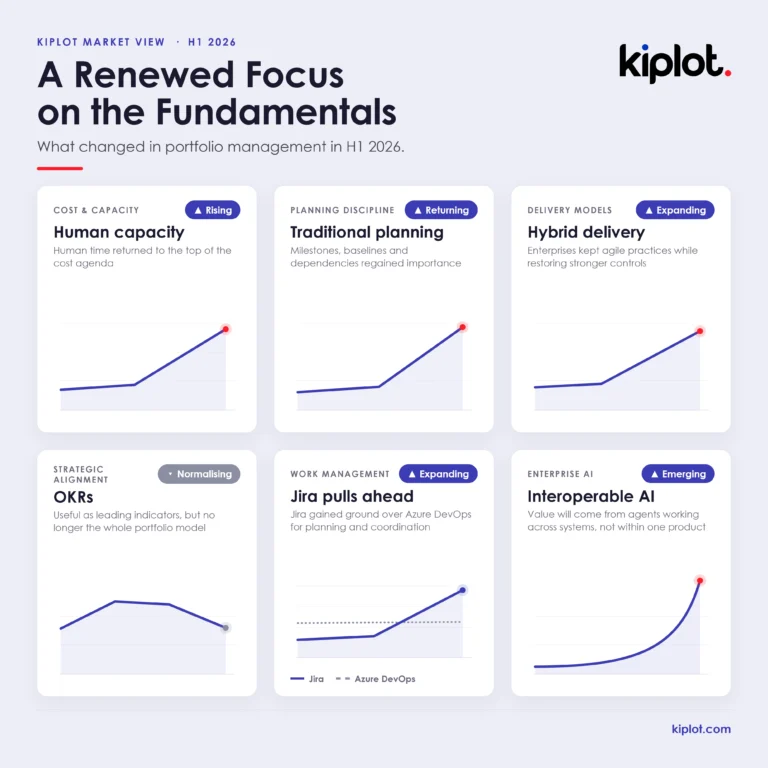 InsightsEnterprise Portfolio Management Trends: 2026 So FarAI dominated the conversation around enterprise portfolio management in the first half of 2026. But beneath the agentic fanfare, self-driving portfolios, synthetic PMOs, copilot-everything and the apparently imminent extinction of…
 AIFrom Plausible Risk Logs to Portfolio Assurance. What we learned building AI risk review for SPM teamsSPM teams don't need another way to fill a risk log. They need a better way to decide which risks deserve attention. What we learned building AI risk review.
 AIAgentic Project Management: How AI agents are changing portfolio delivery without removing human accountabilityMost AI in portfolio management is still reactive: it answers when asked. Agentic Project Management is what acting on its own looks like, and what that shift means for cost per benefit dollar.
 AIAI for the PMO: 8 Use Cases Transforming Portfolio ManagementAs portfolios scale, the PMO's administrative load expands with them. Eight use cases where AI shifts capacity from maintaining visibility to interpreting it.
 knowledgeArchitecting Jira for large organizationsJira's flexibility is also its risk. At scale, it tips into chaos without deliberate structure. How to architect Jira for consistency and data quality without crushing agility.