We use cookies to enhance your browsing experience, serve personalised ads or content, and analyse our traffic. By clicking "Accept All", you consent to our use of cookies.
Preferences
Strictly Necessary
These cookies are essential for the website to function and cannot be switched off.
Functional
Enable enhanced functionality and personalisation, such as videos and live chats.
Analytics
Help us understand how visitors interact with the site by collecting anonymous information.
Marketing
Used to deliver advertisements more relevant to you and your interests.
PMO & EPMO
Do You Need an EPMO?
PMOs vary in scope, authority, and position within the organization. This guide explains how project, program, portfolio, strategic, and enterprise PMOs differ. It also covers how to define the mandate, structure, decision rights, measures, and technology around an enterprise portfolio function.
A PMO is an organizational function that supports the governance, management, or coordination of projects, programs, or portfolios.
The acronym may mean Project Management Office, Program Management Office, or Portfolio Management Office. Its responsibilities depend on the work within its scope, the services it provides, and the decisions it supports.
Term
Definition
Project Management Office
Supports project delivery through planning, controls, assurance, reporting, and agreed methods.
Program Management Office
Supports the coordinated governance and delivery of related projects and workstreams within a program.
Portfolio Management Office
Supports decisions across a portfolio, including intake, prioritization, funding, capacity, risk, performance, and benefits.
Enterprise PMO
Applies portfolio governance across an enterprise or a defined enterprise-wide investment scope.
Strategic PMO
Connects strategic priorities with portfolio decisions and intended outcomes.
Embedded PMO
Operates within a project, program, function, or business unit.
Central PMO
Provides shared services, governance, or oversight across several projects or portfolios.
A PMO supporting a major program may focus on planning, controls, assurance, and reporting. A portfolio-level PMO may coordinate demand, funding, capacity, and performance across a function or business unit. The responsibilities need to be stated explicitly because the PMO title alone does not define them.
What does an EPMO do?
An EPMO governs a defined enterprise portfolio of investments and change.
It connects strategic priorities with demand, business cases, funding, capacity, delivery evidence, and intended outcomes across organizational boundaries. Its scope may cover the full enterprise, several business units, a group-wide technology portfolio, or another portfolio requiring common governance.
EPMO commonly stands for Enterprise Project Management Office. Some organizations use Enterprise Program Management Office or Enterprise Portfolio Management Office. Enterprise Portfolio Management Office is usually the more precise term where the function governs investment and portfolio decisions rather than project delivery alone.
An EPMO needs:
A defined portfolio scope
Clear responsibilities
Named decision forums
Agreed decision and escalation rights
Defined relationships with finance, strategy, delivery, and initiative sponsors
Consistent portfolio information
Measures connected to the work it performs
An organization may establish the same capability through a Strategic PMO, Enterprise Portfolio Office, Transformation Office, Strategy Execution Office, or another structure.
How PMOs and EPMOs differ
The difference between a PMO and an EPMO usually concerns scope and mandate. It is not a universal hierarchy.
Dimension
PMO
EPMO
Typical scope
Project, program, function, business unit, or portfolio
Enterprise or cross-enterprise portfolio
Primary purpose
Delivery support, controls, assurance, governance, or portfolio coordination
Enterprise portfolio governance and decision support
Operating horizon
Delivery plans and portfolio commitments within its scope
Strategic planning, investment cycles, portfolio reviews, and outcomes
Demand
Captures and assesses demand within its remit
Consolidates or governs demand across portfolio boundaries
Prioritization
Ranks work within a project, program, function, or portfolio
Establishes comparable evidence for enterprise trade-offs
Funding
Tracks budgets and forecasts within scope
Connects enterprise investment decisions with current portfolio evidence
Capacity
Coordinates people, roles, or teams within scope
Exposes capacity constraints and trade-offs across portfolios
Delivery relationship
May manage delivery directly or provide delivery services
Usually governs portfolio evidence without owning each initiative
Executive relationship
Reports through a functional or delivery leadership structure
Supports enterprise or cross-functional governance forums
Local PMOs
May operate independently
Coordinates evidence, thresholds, and escalation across local PMOs
Benefits
Tracks outputs or benefits within scope
Governs benefit assumptions and named accountability across the portfolio
A PMO can hold a strategic mandate within a narrower portfolio. An EPMO can remain administrative if its remit stops at consolidated reporting.
An EPMO does not need to replace local PMOs. Business-unit, technology, transformation, and delivery PMOs may retain specialist responsibilities within the enterprise structure.
Project PMO
One project
Focus
Plan, cost, milestones, risk, and assurance
Decisions
Delivery action and escalation
Program PMO
Related projects and workstreams
Focus
Dependencies, integrated delivery, and program outcomes
Decisions
Program sequencing and trade-offs
Portfolio PMO
A function, business unit, or investment portfolio
Focus
Demand, priority, funding, capacity, and performance
Decisions
Portfolio selection and reallocation
EPMO
Enterprise or cross-enterprise portfolio
Focus
Strategic alignment, investment, and cross-portfolio dependencies
Decisions
Enterprise trade-offs and escalation
PMO scope may extend from one project to the enterprise portfolio. Wider scope changes the decisions being supported, but does not make one structure inherently more mature than another.
Related portfolio and transformation offices
Organizations use several names for functions supporting projects, portfolios, and enterprise change. The responsibilities attached to each name vary.
Function
Typical responsibilities
Typical scope
Project Management Office
Project planning, controls, assurance, and reporting
Project, function, or department
Program Management Office
Coordination, dependencies, governance, and reporting across related projects
Defined program
Portfolio Management Office
Demand, prioritization, funding, capacity, risk, and portfolio performance
Defined portfolio
Strategic PMO
Connection between strategic priorities, investment decisions, and portfolio performance
Strategic portfolio or enterprise
Enterprise PMO
Common portfolio information, governance, and escalation across organizational boundaries
Enterprise or cross-enterprise portfolio
Transformation Office
Governance, intervention, and benefit tracking for a defined transformation
Time-bound transformation portfolio
A Transformation Office usually works against a defined transformation case, value target, and delivery horizon. A Strategic PMO or EPMO usually has a continuing remit, even as the investments within its portfolio change.
An organization may contain several of these functions at once. A group EPMO may support major investment decisions while a technology Portfolio Office manages technology demand and a Transformation Office runs a time-bound program. Their responsibilities and escalation routes need to be explicit where their portfolio coverage overlaps.
When an organization needs an EPMO
An organization needs an EPMO, or an equivalent portfolio function, when material decisions crossing portfolios cannot be governed through existing structures.
The case should begin with the decisions that leadership cannot make from the current evidence. It should not begin with a target organization chart.
Signal
What it reveals
Business units approve competing work independently
No forum governs enterprise trade-offs
Strategic initiatives cross several portfolios
Local governance cannot resolve shared dependencies or ownership
Shared teams are committed through separate plans
Capacity is being allocated without an enterprise demand view
Finance and delivery use different portfolio assumptions
Funding, forecast, and delivery evidence describe different plans
The portfolio view is assembled after the underlying information has changed
Business cases disappear after approval
Cost, benefit, risk, and capacity assumptions are not governed through delivery
Local PMOs apply incompatible definitions
Enterprise reporting cannot distinguish portfolio movement from reporting differences
Benefits lose ownership after project closure
Delivery completion has replaced outcome accountability
No forum can stop work across portfolio boundaries
Lower-value commitments continue because authority remains local
Strategic priorities change without corresponding portfolio action
Funding and capacity remain attached to the previous plan
A new EPMO is not the only response. The organization may need stronger decision rights, a cross-portfolio investment committee, common portfolio definitions, or clearer escalation thresholds.
A formal EPMO may add little where one function controls the relevant portfolio, the existing governance forum holds suitable authority, and portfolio evidence is current. Another office in that situation may duplicate services without improving decisions.
Leadership should be able to answer the following questions from governed evidence:
Which investments support current strategic priorities?
What has been approved, funded, and committed?
Does the portfolio fit available capacity?
Which dependencies cross portfolio boundaries?
Which business-case assumptions have changed?
Where is intervention required?
Which forum owns the decision?
Who remains accountable for the intended outcome?
Gaps in those answers show where the current structure needs to change. The scope and permanence of those gaps determine whether a dedicated EPMO is required.
How to define the EPMO mandate
The mandate sets out what the EPMO prepares, reviews, recommends, records, escalates, or approves.
A broad remit without corresponding authority creates an advisory office carrying enterprise expectations. Extensive control without an agreed mandate creates conflict with finance, strategy, delivery, and business leadership.
The mandate should be documented in an EPMO charter or equivalent agreement.
Mandate question
Required decision
Which portfolios are in scope?
Define the business units, functions, geographies, investment categories, or strategic themes covered.
Which work types are included?
State whether the scope includes projects, programs, products, regulatory work, technology change, and run activity.
Which thresholds apply?
Set materiality by cost, risk, strategic significance, dependency exposure, or another governed factor.
Which responsibilities sit with the EPMO?
Define the portfolio processes the office performs directly.
Which decisions can it make?
Separate approval authority from recommendation, assurance, and escalation.
Which forums does it support?
Name the investment committee, steerco, MBR, portfolio review, or planning forums involved.
Which evidence does it govern?
Define data ownership, reporting standards, effective dates, and source systems.
Which responsibilities remain local?
Record the decisions retained by business units, local PMOs, finance, delivery teams, and initiative owners.
Which exclusions apply?
State which work, portfolios, or operational decisions sit outside the mandate.
How will the mandate be reviewed?
Set a review point based on organizational or portfolio change.
Define the enterprise portfolio boundary
The enterprise portfolio may contain more than projects.
It may include strategic initiatives, regulatory programs, products, platforms, business transformations, technology investments, and major run commitments. Each work type carries different planning assumptions and delivery evidence.
A product team may operate through a continuing backlog and fixed team cost. A capital program may use a defined business case, stage gates, named milestones, and a temporary delivery organization. A regulatory commitment may have a fixed deadline and limited discretion over whether the work proceeds.
The EPMO should establish the minimum comparable evidence required for portfolio decisions. It should not force each work type into the same delivery method. That evidence may include:
Accountable sponsor
Intended outcome
Strategic connection
Delivery window
Funding and forecast
Capacity requirement
Material dependencies
Current confidence
Benefit assumptions
Decision history
The level of detail should match the decision. An early proposal does not need the same delivery plan as funded work. Requiring precise dates, named resources, and complete financial profiles before assessment creates false confidence and unnecessary administration.
The portfolio should include material run commitments where they consume the same funding or capacity as change. A plan that considers new investment without visible operational demand will overstate what the organization can take on.
Set proportionate governance thresholds
The EPMO does not need to review every request directly.
Materiality may be defined through investment value, regulatory exposure, strategic significance, shared capacity, customer impact, operational impact, or executive commitment.
A minor local change may require delivery control without entering the enterprise portfolio. A lower-cost regulatory initiative may require enterprise governance because it spans several functions and carries a fixed obligation.
Thresholds should determine which evidence, approvals, and review cadence apply. Cost alone is rarely sufficient.
How to assign decision rights
An EPMO prepares the evidence for portfolio decisions, challenges the assumptions, records the outcome, and tracks agreed actions.
Approval authority remains with the person or forum named in the governance policy. The EPMO may hold delegated authority for defined decisions, but those limits need to be explicit.
Decision
EPMO responsibility
Accountable role or forum
Admit a request into assessment
Apply intake criteria and route the request
Portfolio owner or delegated intake authority
Approve a business case
Challenge the evidence and prepare the recommendation
Investment committee or delegated executive
Set portfolio priority
Apply the agreed method and present the trade-offs
Portfolio owner or investment committee
Release funding
Confirm conditions and record the decision
Finance and delegated investment authority
Move capacity between commitments
Model the impact and prepare the recommendation
Functional leadership or portfolio forum
Change an approved delivery date
Assess dependencies, benefits, and financial effect
Sponsor or governance forum within tolerance
Accept a material risk
Record the exposure and escalate against policy
Named risk owner or executive forum
Pause or stop an initiative
Present current evidence and consequences
Investment committee or accountable sponsor
Approve lifecycle progression
Test readiness against agreed criteria
Named stage-gate authority
Confirm benefit realization
Validate the evidence and maintain the portfolio record
Named benefit owner or initiative sponsor
A statement that the EPMO owns prioritization is incomplete. The mandate should specify whether the office defines the method, scores initiatives, moderates the discussion, recommends an order, or approves the final portfolio.
Keep accountability with named roles
The initiative sponsor remains accountable for the approved business case and intended outcome.
A separate benefit owner may be accountable for a specific measure where the sponsor does not control the activity required to realize it. The delivery lead remains accountable for the plan, milestones, dependencies, forecast, and execution.
Role
Accountability
Initiative sponsor
Approved business case, strategic rationale, intended outcome, and continued justification
Benefit owner
Measurement and realization of an assigned financial or non-financial benefit
Delivery lead
Delivery plan, milestones, dependencies, risks, cost forecast, and execution
Finance
Financial policy, rates, accounting treatment, actuals, and delegated funding controls
EPMO
Portfolio evidence, review process, decision records, conditions, and escalation
The EPMO should make unclear accountability visible. It should not resolve that ambiguity by taking ownership itself.
Decides: set portfolio priorities, approve material investment, release funding, accept material risk, pause or stop work.
2 · EPMO
Prepare portfolio evidenceChallenge assumptionsModel trade-offsPrepare steerco and MBRRecord decisions and conditionsTrack actions and escalation
Connects the approval above with delivery below, and maintains the portfolio evidence and the review process.
3 · Initiative and delivery leadership
Initiative sponsorBenefit ownerProgram or project leadershipProduct or platform leadershipFunctional resource owners
Accountable for: maintaining the business case, delivering the approved scope, managing milestones and dependencies, maintaining the forecast, and realizing the intended benefits.
4 · Evidence returned to governance
Actual costForecast movementDelivery movementCapacity useRisk exposureBenefits realized
The evidence produced by delivery.
Evidence returns to the EPMO and the accountable governance forum, informing the next set of priorities, approvals, and interventions.
The EPMO prepares the evidence and records the decision. Executive forums retain approval authority, while named sponsors, benefit owners, and delivery leaders remain accountable for the investment.
Centralized, hub-and-spoke, and federated structures
Centralized, hub-and-spoke, and federated are established ways of describing EPMO structures. The boundaries vary between organizations, so the terms should be treated as practical descriptions rather than fixed standards.
Structure
How it works
Best fit
Main challenge
Centralized
One EPMO performs most portfolio processes and maintains common standards
Portfolios with concentrated investment authority and material cross-functional dependencies
Distance from local delivery context
Hub-and-spoke
A central EPMO sets shared requirements while local PMOs manage portfolio activity closer to delivery
Large enterprises with several business units, functions, or delivery models
Duplicate work where responsibilities are unclear
Federated
Local portfolios retain defined authority within enterprise principles and escalation rules
Diversified or geographically distributed enterprises
Local variation weakening enterprise comparability
Organizations may combine elements of all three. A regulated portfolio may use centralized controls while commercial business units retain more local authority.
Centralized
EPMO
Connected directly to
Business unitsTechnologyFinanceTransformation programsDelivery teams
Local responsibilities: prioritization, funding, and capacity within delegated limits.
The right structure depends on where investment authority, portfolio knowledge, and delivery accountability sit. Each approach requires clear boundaries between enterprise and local responsibilities.
Centralized EPMO
A centralized EPMO performs the enterprise portfolio process directly.
It may manage intake, business-case standards, prioritization, portfolio reporting, stage gates, and executive governance across the defined scope. Local teams provide delivery evidence but do not maintain separate portfolio processes.
This structure suits an organization with concentrated investment authority, material cross-functional dependencies, or a need to establish common control quickly.
The main challenge is distance from local context. A central team may apply consistent rules without understanding the operational detail needed to interpret the evidence.
Hub-and-spoke EPMO
A hub-and-spoke structure separates enterprise responsibilities from local portfolio management.
The central office defines shared terms, materiality thresholds, governance requirements, data standards, and executive reporting. Local PMOs manage planning, assurance, and portfolio routines within their business or delivery context.
A technology PMO may retain detailed architecture and delivery controls. A business transformation PMO may use a different lifecycle. Both provide agreed evidence to the enterprise portfolio.
The responsibilities need clear boundaries. If the hub and spokes prepare the same reports, moderate the same decisions, or maintain separate portfolio records, the structure adds reconciliation.
Federated EPMO
A federated structure gives local portfolios greater authority.
Business units may approve work, prioritize demand, and allocate capacity within agreed investment limits. The enterprise function maintains group-wide principles, consolidates material exposure, and intervenes where decisions cross portfolio boundaries.
Federation suits organizations where business units hold distinct financial accountability or operate in materially different markets.
The center still needs authority over common definitions and escalation. Without it, the enterprise view becomes a collection of local reports that cannot be compared.
The EPMO needs an executive sponsor and access to the forums that make material portfolio decisions. Its formal reporting line depends on the scope of the portfolio and the authority required.
Reporting line
Natural emphasis
Risk to manage
CEO or strategy leadership
Enterprise priorities, strategic initiatives, and cross-functional investment
Distance from financial and delivery detail
CFO
Business cases, investment controls, forecast, capex and opex, and benefits
Portfolio governance narrowing into financial control
COO
Execution, operating performance, dependencies, and intervention
Strategic selection receiving less attention
CIO or CTO
Technology investment, architecture, capacity, and delivery
Enterprise scope becoming an IT portfolio by default
Transformation leadership
Cross-functional initiatives, delivery pace, accountability, and benefits
A time-bound transformation structure becoming permanent
Business-unit executive
Local strategy, investment, and delivery
Limited authority over cross-enterprise dependencies
The formal reporting line and governance sponsorship may differ.
An EPMO may report to the CFO while the CEO chairs the enterprise investment committee. A technology EPMO may report to the CIO while finance retains investment approval rights. A Transformation Office may report to a Chief Transformation Officer while initiative accountability remains within the relevant business function.
The office needs access to the forums where its evidence is used. Its independence should match the level of challenge and assurance expected of it.
What responsibilities belong with the EPMO?
An EPMO may perform several portfolio responsibilities. It does not need to perform each activity directly.
Discipline
EPMO responsibility
Strategy and portfolio alignment
Connect investments with strategic objectives, themes, OKRs, or enterprise measures.
Demand and intake
Maintain a governed view of current and proposed work.
Business cases
Define evidence requirements and keep approved assumptions available for later review.
Prioritization
Apply comparable criteria and present trade-offs across competing demand.
Funding and portfolio financials
Connect approved investment with forecast, actuals, run-rate, and funding decisions.
Capacity planning
Compare current and proposed demand with available people, teams, roles, and skills.
Roadmaps and dependencies
Maintain a cross-portfolio view of sequencing, milestones, and material dependencies.
Lifecycle governance
Apply proportionate controls from idea through delivery and benefit realization.
Risk and assurance
Consolidate material exposure, run assurance activity, and route exceptions.
Portfolio reporting
Present current performance, movement, confidence, and required decisions.
Benefits and value
Maintain benefit assumptions, measures, evidence, and named accountability.
Data and systems
Maintain portfolio definitions, integrations, data ownership, and reporting logic.
Governance support
Prepare forums, record decisions, track conditions, and escalate overdue actions.
Not every responsibility needs to sit inside the EPMO. Finance may own rates and actuals. HR may own workforce data. Local PMOs may run lifecycle reviews within their portfolios.
The EPMO needs a clear route for each discipline to contribute evidence to the same portfolio decisions. Together, these disciplines form part of Strategic Portfolio Management.
How the EPMO prepares portfolio reviews
The EPMO prepares portfolio reviews, challenges the evidence, records decisions, and tracks the resulting actions.
A typical enterprise cadence may include:
Cadence
Main inputs
Typical decisions
Annual or strategic planning
Strategic priorities, financial envelope, workforce outlook, and major commitments
Portfolio direction, broad investment allocation, major starts and stops
Quarterly or PI planning
Current priorities, proposed work, capacity, dependencies, and forecast
Portfolio sequence, team commitments, funding changes, and roadmap movement
Monthly MBR or portfolio review
RAG, milestones, forecast, actuals, benefits, risk, and material change
Intervention, reforecasting, escalation, reallocation, and stop recommendations
Lifecycle review
Business case, readiness evidence, risk, dependencies, and capacity
Approve, condition, rework, pause, reject, or progress
Exception review
Threshold breach, material risk, or significant forecast movement
Action within delegated authority or escalation to the next forum
The names and timings vary. The requirement is a defined route from evidence to decision.
The EPMO should define tolerances. A movement within an approved range may remain with the initiative sponsor. A change affecting strategic outcomes, funding, a regulatory commitment, or a material dependency should return to the accountable forum.
Decision conditions also need tracking. An initiative approved subject to a revised supplier agreement or confirmed capacity has not received unconditional approval. The portfolio record should preserve that distinction.
How to assess PMO and EPMO maturity
PMO maturity is not a fixed sequence ending in an EPMO.
Becoming an EPMO changes scope. It does not prove greater maturity.
An organization may have mature reporting and weak decision rights. Another may have clear authority and poor portfolio information. A third may govern investment well but lose benefit accountability after delivery.
Maturity should be assessed across separate dimensions.
Dimension
Typical gap
More mature practice
Mandate
Responsibilities depend on informal expectations
Scope, responsibilities, authority, and exclusions are documented
Scope
Portfolio coverage changes by report or meeting
Materiality and portfolio boundaries are governed
Decision rights
Recommendations and approvals are confused
Each material decision has a named authority
Governance
Reviews focus on updates
Forums make and record portfolio decisions
Information
Reports require manual reconciliation
Portfolio evidence uses governed definitions and effective dates
Integration
Finance, strategy, and delivery describe different plans
Portfolio decisions use connected financial and delivery evidence
Hybrid delivery
One method is imposed across all work
Comparable governance works across project, product, agile, and hybrid delivery
Outcomes
Governance ends at delivery completion
Benefits remain tied to named sponsors and benefit owners
Adaptability
Portfolio changes wait for annual planning
Priorities, funding, and capacity can change through controlled review
Assurance
Risk and confidence depend on self-reporting
Evidence is challenged against agreed standards and thresholds
The maturity assessment should identify the specific gap to address next. An organization with current portfolio data but unclear approval authority needs different action from one still reconciling basic financial and delivery information.
Example organization
Mandate
Responsibilities depend on informal expectationsScope, responsibilities, and authority are documented
Scope
Portfolio coverage changes by meeting or reportMateriality and portfolio boundaries are governed
Decision rights
Recommendations and approvals are unclearEach material decision has a named authority
Governance
Forums review statusForums make and record decisions
Information
Reports require manual reconciliationEvidence uses governed definitions and effective dates
Integration
Finance and delivery describe different plansFinancial and delivery evidence supports the same decision
Outcomes
Governance ends at deliveryBenefits remain tied to named sponsors and benefit owners
PMO maturity develops unevenly. The next improvement should address the constraint affecting portfolio decisions rather than pursue a different title or a single maturity score.
How to measure PMO and EPMO effectiveness
The EPMO should be measured against the responsibilities it has been given. A delivery PMO may be judged on forecast accuracy and milestone confidence. An EPMO responsible for investment governance also needs measures covering portfolio alignment, decision turnaround, capacity, and benefits.
Category
Example measures
What the measure shows
Portfolio alignment
Investment by strategic objective, unaligned spend, priority drift
Whether the portfolio reflects current strategy
Investment quality
Business-case confidence, approval cycle time, forecast movement
Whether decisions use credible evidence
Portfolio choice
Work stopped, deferred, reshaped, or reallocated
Whether governance changes the portfolio rather than only reporting it
Delivery confidence
Milestone predictability, dependency exposure, material RAG movement
Whether current commitments remain credible
Capacity
Demand against capacity, scarce-skill exposure, committed versus available capacity
Whether the approved portfolio is deliverable
Financial control
Forecast accuracy, budget variance, run-rate, capex and opex position
Whether financial evidence remains current
Outcomes
Benefit forecast movement, value realized, named benefit ownership
Whether investments remain accountable for results
Reporting latency, reconciliation effort, data completeness
Whether the portfolio process requires unnecessary administration
Stakeholder service
Decision usefulness, evidence quality, service adoption
Whether the office meets the needs defined in its mandate
Targets should reflect the organization's context and starting point. A universal threshold for strategic alignment or portfolio health creates false precision.
Composite health measures can provide a summary. The financial, delivery, capacity, risk, and benefit movement underneath the score should remain visible.
The scorecard should show whether the EPMO improves the quality and speed of portfolio decisions.
Common PMO and EPMO challenges
PMO and EPMO structures become less effective when authority is unclear, responsibilities overlap, or portfolio information does not support the decisions being made.
Challenge
What it causes
What to change
The PMO is renamed without changing its scope or authority
The EPMO title creates expectations that the team cannot meet
Define the portfolio scope, responsibilities, and decision rights before changing the structure
Every request enters the same process
Excess control and local workarounds
Set routes and thresholds by materiality and work type
The EPMO owns initiative delivery
Accountability moves away from the sponsor and delivery lead
Keep accountability with named roles
Reporting becomes the primary service
Governance reviews information without acting
Define decisions, tolerances, and escalation routes
Standards override context
Local functions create parallel processes
Standardize portfolio evidence without prescribing each delivery method
Local PMOs and the EPMO duplicate work
Reconciliation increases
Define central and local responsibilities
Technology arrives before governance
New reporting exposes unresolved authority without resolving it
Define decision rights, forums, and data ownership first
Benefits sit with the PMO
Sponsors disengage after approval
Assign each benefit to a person able to influence its realization
Business cases become static
The portfolio continues against outdated assumptions
Review cost, value, risk, timing, and capacity through delivery
Every issue escalates centrally
Executive governance becomes congested
Set tolerances and delegated authority
Portfolio data has no effective date
Reports combine information from different points in time
Govern reporting periods and source dates
Composite scores replace evidence
Material movement is hidden by an average
Keep the underlying financial, delivery, capacity, risk, and benefit measures visible
An EPMO should make enterprise decisions easier to prepare, govern, and record. Another reporting layer does not improve the portfolio when authority and responsibilities remain unclear.
How software should support the EPMO
Enterprise portfolio governance requires connected information across strategy, investment, capacity, delivery, risk, and outcomes.
Project-management tools answer questions within a team or project. The EPMO needs a portfolio environment that preserves local delivery systems while connecting their evidence to enterprise decisions.
Capability
What the EPMO needs
Portfolio hierarchy
Represent portfolios, programs, products, initiatives, projects, and run activity without forcing one structure
Strategy connection
Link investments to strategic objectives, OKRs, KPIs, and outcome measures
Intake and business cases
Capture demand at the appropriate level of maturity
Prioritization
Apply configurable criteria, weightings, evidence, and approval rules
Portfolio financials
Connect budget, funding, forecast, actuals, capex, opex, and expected value
Capacity planning
Plan by individual, role, skill, team, function, or supplier
Roadmaps
Present timing, milestones, sequencing, and dependencies across work types
Lifecycle governance
Configure stages, approvals, evidence, conditions, and tolerances
Benefits
Maintain financial and non-financial outcome commitments through delivery
Risk and assurance
Consolidate material exposure while preserving named ownership
Status reporting
Show current position, movement, confidence, and required decisions
Scenario planning
Compare portfolio choices before changing the approved plan
Decision records
Preserve decisions, rationale, conditions, owners, and dates
Permissions
Control who can view, change, approve, and administer portfolio evidence
Integration
Connect delivery, finance, workforce, service, and enterprise systems
Configuration
Reflect the organization's terminology, hierarchy, lifecycle, and governance structure
Audit
Maintain history across changes to scope, cost, value, status, and approval
Jira and Azure DevOps may remain the systems where teams manage delivery. Portfolio governance should use the evidence required for enterprise decisions without creating repeated data entry or a separate reporting process.
Kiplot connects the enterprise portfolio to Jira and Azure DevOps. Delivery teams continue to work in those systems, while Kiplot maintains the strategy, investment, capacity, governance, and benefits information used in portfolio reviews.
For a detailed framework for defining requirements, evaluating vendors and running enterprise PMO software demonstrations, see the PMO Software Buyer’s Guide.
Where AI applies in the EPMO
AI applies first to work that depends on reading, checking, comparing, and summarizing portfolio evidence.
It can draft status narratives, identify missing business-case evidence, compare portfolio reporting with source-system data, surface changes in risk or dependencies, and prepare material for steerco and MBR.
These applications reduce the effort required to chase updates and reconcile repeated narratives. They do not remove the need for clear ownership, governed source data, or named approval authority.
The EPMO needs to define:
Which portfolio records AI may update
Which evidence AI may draft or summarize
Which recommendations require named review
Which thresholds trigger escalation
Which decisions require human approval
How actions, recommendations, and approvals are recorded
AI also raises the standard required of the underlying portfolio information. An AI-generated answer is not reliable when initiatives, costs, dates, risks, and benefits use inconsistent definitions or sit across disconnected records.
Kiplot's AI in the PMO Guide covers the data, governance, and accountability required before AI can support material portfolio decisions.
PMO and EPMO frequently asked questions
What does EPMO stand for?
EPMO commonly stands for Enterprise Project Management Office. Some organizations use Enterprise Program Management Office or Enterprise Portfolio Management Office. Enterprise Portfolio Management Office is usually the more precise term where the office governs enterprise investment and portfolio decisions rather than project delivery alone.
What is the difference between a PMO and an EPMO?
A PMO may operate at project, program, function, business-unit, or portfolio level. An EPMO operates across a defined enterprise scope. It supports decisions and maintains evidence that cross organizational boundaries.
Does every enterprise need an EPMO?
No. An enterprise needs credible portfolio governance. That governance may sit within an EPMO, Strategic PMO, Portfolio Office, Transformation Office, finance function, strategy team, or another structure. A formal EPMO is justified when the scope and permanence of cross-enterprise decisions require a dedicated function.
Can an organization have more than one EPMO?
An organization can have several offices using the EPMO title across regions, divisions, or major portfolio domains. Their scopes and escalation routes need to be explicit. Two offices claiming authority over the same portfolio create ambiguous governance.
Does an EPMO need to report to the CEO?
No. An EPMO may report to the CEO, CFO, COO, CIO, CTO, strategy leadership, transformation leadership, or another executive. The reporting line should match the portfolio scope and provide access to the forums where material decisions are made.
What responsibilities should an EPMO hold?
An EPMO may support strategy alignment, intake, business cases, prioritization, funding, capacity, roadmaps, lifecycle governance, reporting, and benefits. The exact responsibility split depends on what already sits with finance, strategy, delivery functions, local PMOs, and executive governance forums.
What software does an EPMO need?
An EPMO needs portfolio management software that connects strategy, demand, business cases, prioritization, funding, capacity, delivery, risk, and benefits. The platform should integrate with delivery and enterprise systems rather than require each team to manage its work in the portfolio tool. It should also preserve permissions, decision history, effective dates, and the evidence used by executive governance.
Give the EPMO one connected view of the enterprise portfolio
Kiplot connects strategy, business cases, prioritization, funding, capacity, delivery, and benefits in one Strategic Portfolio Management environment. Jira and Azure DevOps stay the systems where teams deliver, while current evidence feeds portfolio governance. The organization keeps control of its terminology, lifecycle, decision rights, and reporting.

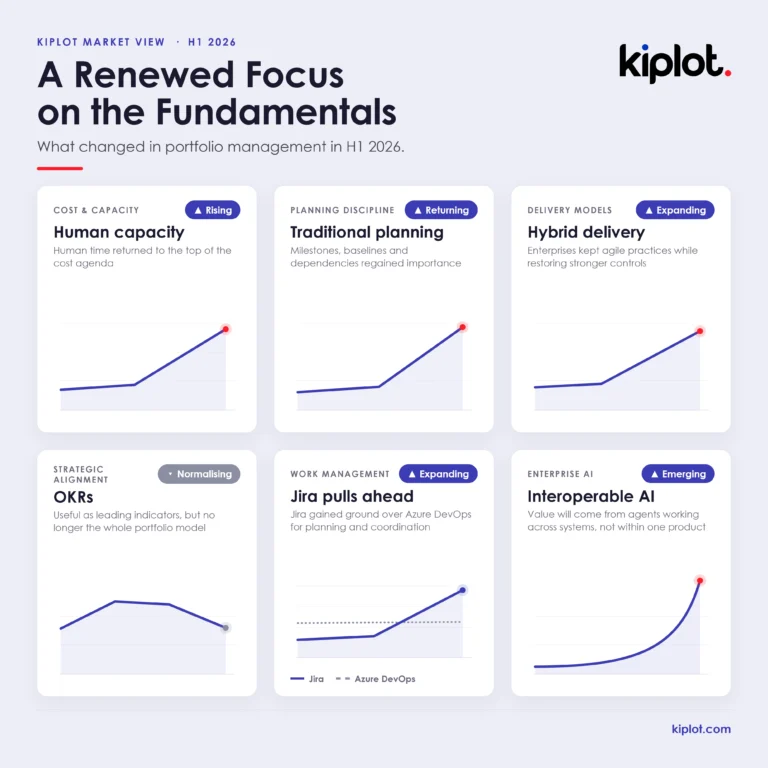 InsightsEnterprise Portfolio Management Trends: 2026 So FarAI dominated the conversation around enterprise portfolio management in the first half of 2026. But beneath the agentic fanfare, self-driving portfolios, synthetic PMOs, copilot-everything and the apparently imminent extinction of…
 AIFrom Plausible Risk Logs to Portfolio Assurance. What we learned building AI risk review for SPM teamsSPM teams don't need another way to fill a risk log. They need a better way to decide which risks deserve attention. What we learned building AI risk review.
 AIAgentic Project Management: How AI agents are changing portfolio delivery without removing human accountabilityMost AI in portfolio management is still reactive: it answers when asked. Agentic Project Management is what acting on its own looks like, and what that shift means for cost per benefit dollar.
 AIAI for the PMO: 8 Use Cases Transforming Portfolio ManagementAs portfolios scale, the PMO's administrative load expands with them. Eight use cases where AI shifts capacity from maintaining visibility to interpreting it.
 knowledgeArchitecting Jira for large organizationsJira's flexibility is also its risk. At scale, it tips into chaos without deliberate structure. How to architect Jira for consistency and data quality without crushing agility.