


On this page
AI dominated the conversation around enterprise portfolio management in the first half of 2026. But beneath the agentic fanfare, self-driving portfolios, synthetic PMOs, copilot-everything and the apparently imminent extinction of the project manager, several more consequential shifts were taking place in how portfolios were actually being run.
Enterprise organizations placed even greater weight on the foundations that make portfolio decisions trustworthy. After a period in which agile transformation and operating-model change often dominated the agenda, attention shifted back towards the less glamorous disciplines that determine whether portfolio management works at all: reliable data, clear ownership, consistent financial and capacity information, and controls that allow recommendations to be explained, challenged and approved.
AI did not make these fundamentals less important. It made clear that every credible use of AI depends on them.
The result was a market talking loudly about AI while quietly returning to the disciplines that make portfolio management credible. Against that backdrop, these are Kiplot’s most important trends from the first half of 2026, whether organizations call the discipline project portfolio management, strategic portfolio management or something else entirely.
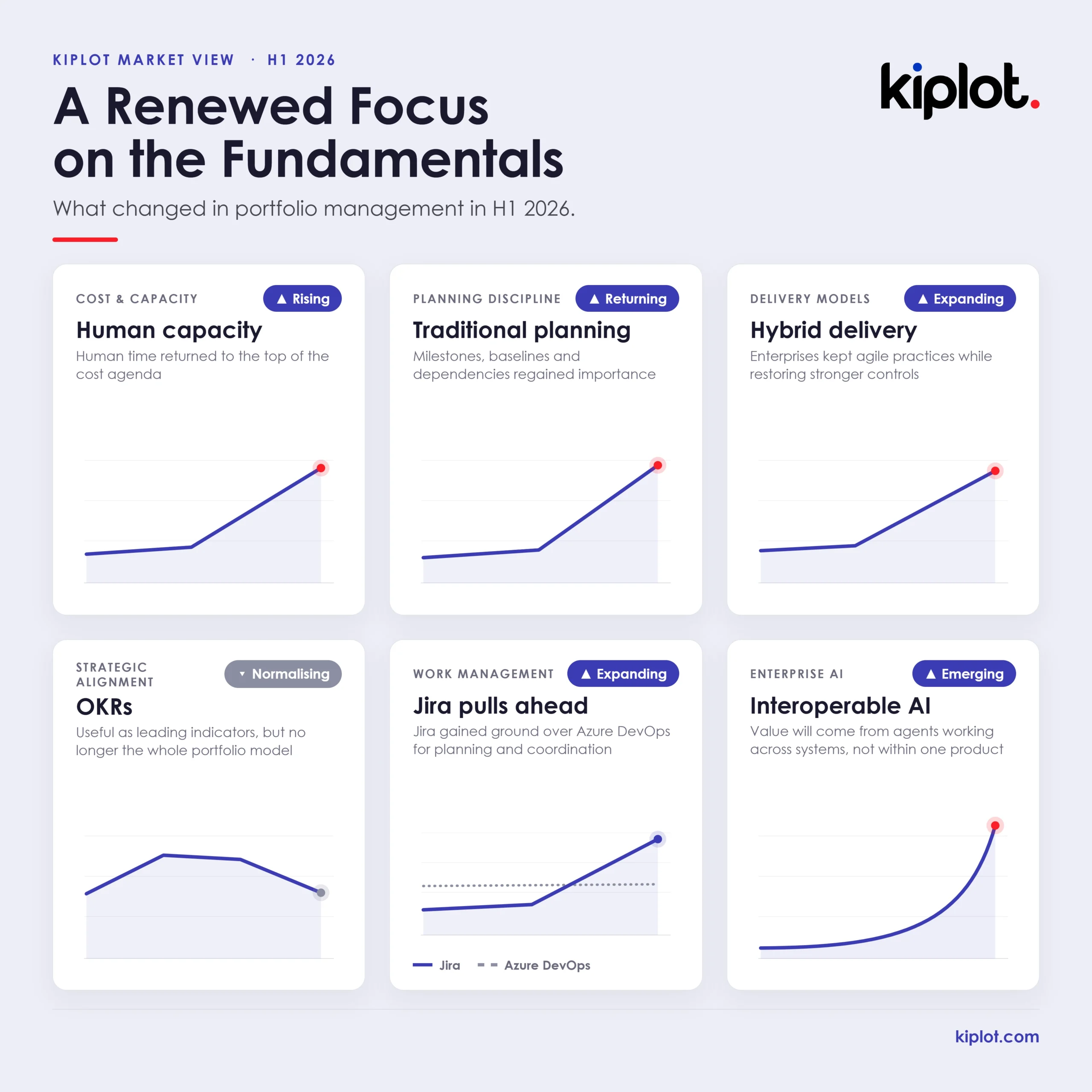
Human capacity returned to the cost agenda
Resource cost never stopped being a core portfolio concern. But after a period in which agile transformation, operating-model change and delivery methodology often consumed executive attention, the spotlight swung back towards a more basic question: what are we paying people to work on, and what are we getting in return?
AI intensified that scrutiny. Executives were increasingly asking whether work performed by people could instead be automated, accelerated or eliminated. Whether the technology can yet support many of those assumptions remains unproven, but the burden of proof has shifted. Technology leaders are once again being asked to justify human capacity in detail: where it is allocated, which initiatives consume it, and whether the resulting outcomes warrant the cost.
At the same time, AI introduced a new and rapidly expanding cost base. Organizations began seeking to attribute licences, model usage, tokens, compute and agent workloads to reporting lines, strategic priorities and business outcomes. Human capacity and AI expenditure were no longer being treated as separate conversations. They were increasingly competing within the same constrained technology budget.
Across the enterprise portfolios we encountered, AI budgets were more commonly reallocated than added. Technology leaders were challenging duplicated or underused software, discretionary initiatives and existing headcount assumptions to create room within current spending envelopes.
The same pressure was visible in how AI investment was approved. CIO.com’s 2026 State of the CIO survey found that only 19% of respondents said AI initiatives had met or exceeded business goals, while 32% identified ill-defined ROI measures as a barrier to scaling. The research also described a move towards stage-gated funding, with investment tied to specific business outcomes and reviewed against defined milestones.
Traditional planning returned, without abandoning agile
For years, “wagile” was treated as a joke: the worst of waterfall bolted onto the rituals of agile. By H1 2026, that dismissal looked increasingly simplistic.
The idea that large enterprises could organize entirely around autonomous, durable teams, make only short-term commitments and allow priorities to emerge continuously came under greater scrutiny. In many organizations, the promised benefits of a pure agile model had not materialized at enterprise scale. Speed improved in places, but coordination, predictability and accountability often weakened.
The response was not a return to months-long design phases, fixed multi-year plans or detailed requirements written before delivery begins. Organizations still wanted the benefits of agile: shorter feedback loops, smaller releases, MVPs, empowered teams and operating models built around enduring domain knowledge rather than temporary pools of specialist skills.
What returned were the disciplines that agile transformation had sometimes pushed aside: milestones, baselines, dependency planning, slippage tracking, credible business cases and explicit accountability for delivery.
House of PMO’s 2026 trends analysis reflected this shift, highlighting stronger pre-investment scrutiny, capacity-led prioritization and fit-for-purpose hybrid delivery as prominent practitioner concerns across its member conversations, roundtables, events and training work.
The principle is straightforward. Governance forums need enough information to challenge weak, poorly defined or politically sponsored proposals before scarce capacity is committed. Prioritization is not credible when initiatives enter the portfolio without a clear problem statement, realistic resource assumptions, understood dependencies or measurable outcomes.
The same logic sits behind the renewed interest in hybrid delivery. Enterprises are becoming less ideological about method and more deliberate about matching governance to the work.
Agile remains well suited to digital products and software delivery where uncertainty is high and frequent feedback improves the result. More structured, stage-gated approaches remain appropriate for regulatory programs, infrastructure change and large transformations where missed dependencies, late discoveries or uncontrolled slippage can create material financial or operational risk.
A portfolio containing both a core banking migration and a mobile application does not need a single delivery methodology. It needs a common planning discipline capable of governing both.
OKRs returned to their proper place
The hype around OKRs has faded. They remain useful for translating strategy into clearer goals, aligning teams and tracking leading indicators of progress. But they do not alter the lagging indicators against which organizations are ultimately judged: did the investment increase revenue, reduce cost, lower risk or satisfy a regulatory obligation?
In some organizations, OKRs had become a cottage industry of their own: layers of objectives, key results, alignment workshops and reporting cycles that generated considerable activity without necessarily improving investment decisions. That was unlikely to be what John Doerr had in mind.
When the dust settles, organizations still need to know whether an initiative justified its cost, whether the capacity committed to it could have been used better elsewhere, and whether the promised value actually materialized.
OKRs can help connect day-to-day work to strategic intent and provide earlier signals of progress. Increasingly, however, they are being treated as one useful input into funding, capacity and value decisions, rather than as the organizing model for the portfolio.
Jira appeared to pull ahead of Azure DevOps
Across our H1 customer and prospect conversations, a number of long-running Jira-versus-Azure DevOps debates appeared to be reaching a conclusion.
Several organizations were exploring moves away from Azure DevOps for planning and work management, with Jira increasingly becoming the preferred environment for coordinating delivery across engineering, product and adjacent business teams.
Azure DevOps remained deeply embedded in many engineering toolchains, particularly for repositories, pipelines and release management. But when organizations wanted a common system for managing work across a broader set of teams, Jira was more often emerging as the default choice.
This was not a universal shift, and many enterprises continued to operate both platforms. But the direction of travel was notable. Internal debates that had previously remained unresolved were increasingly producing a clear winner, with Jira gaining ground as the primary system for planning and coordinating work.
Enterprise AI moved beyond the portfolio interface
Most AI in portfolio management remains reactive. It prepares summaries, reviews business cases, compares scenarios and identifies potential risks when someone asks it to.
Where vendors such as ServiceNow, Planview, Atlassian and Microsoft announced increasingly capable embedded assistants and agents, the more important long-term shift was beginning to emerge elsewhere: in how AI operates across the enterprise rather than within any single system.
In the near term, the most valuable use cases remain practical. AI can reconcile data, monitor changes, maintain records and prepare the evidence required for a decision. These are repetitive tasks that portfolio teams struggle to perform consistently and that materially affect the quality of decision-making.
The larger opportunity lies in interoperability. Agents will increasingly need to work across systems of record, exchange context with one another and surface portfolio information inside the tools where employees already work, including platforms such as Microsoft Copilot.
This will change the basis of competition. The important question will become less about what a portfolio system’s embedded AI can do in isolation, and more about how effectively that system participates in the organization’s wider AI layer.
The most valuable experiences may be almost invisible to the end user. Information will appear where it is needed, actions will move between systems, and decisions will be supported without requiring people to understand the technical complexity beneath them.
Portfolio platforms will therefore need to expose trusted data, clear permissions, reliable actions and sufficient context for external agents to operate safely. The real value will come from interoperability, not from forcing users into another proprietary AI interface.
Human oversight will still matter. Organizations will need explicit rules covering what an agent can do independently, which actions require approval and what evidence must be retained. AI may take responsibility for tasks, but decision authority and accountability remain with people.
The economic test will also become stricter. Faster summaries have value, but they do not materially improve portfolio performance on their own. The more important question is whether AI reduces the administrative cost of delivery and gives decision-makers better evidence without adding headcount.
What comes next for enterprise portfolio management
The common thread across H1 2026 was a higher standard for portfolio decisions. Organizations were applying greater scrutiny to the data, cost, capacity and governance behind decisions to fund, prioritize, continue or stop work.
That raises the standard expected of portfolio teams. RAG status, milestone progress, spend to date and forecast run-rate remain necessary, but they are no longer sufficient. Leaders also need to understand whether the original business case still holds, whether the required capacity exists, which dependencies threaten delivery and whether the expected value is materializing.
AI will increasingly perform the reconciliation, monitoring and follow-up required to prepare those decisions. Over time, much of that work will happen across systems and surface inside the tools leaders already use. But AI will not remove the need for clear ownership or accountable judgment.
The authority to continue, reallocate or stop investment will remain with the leaders responsible for the portfolio. Strategic portfolio management will increasingly be judged by whether it gives them enough reliable evidence to make those decisions while there is still time to act.