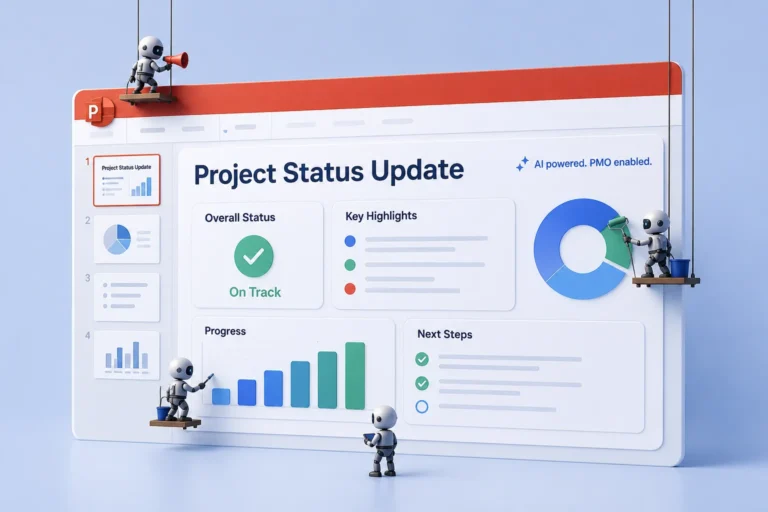
As portfolios scale, the PMO's administrative load expands with them. Eight use cases where AI shifts capacity from maintaining visibility to interpreting it.
We use cookies to enhance your browsing experience, serve personalised ads or content, and analyse our traffic. By clicking "Accept All", you consent to our use of cookies.
Preferences
Strictly Necessary
These cookies are essential for the website to function and cannot be switched off.
Functional
Enable enhanced functionality and personalisation, such as videos and live chats.
Analytics
Help us understand how visitors interact with the site by collecting anonymous information.
Marketing
Used to deliver advertisements more relevant to you and your interests.
The Enterprise Guide to AI in Project Portfolio Management
AI is becoming part of the systems used to plan, govern and report portfolios across enterprise organizations, from analysis and reporting through to agents that can prepare or execute actions. This guide explains where those capabilities are useful, what they need to work reliably, and how to introduce and evaluate them without weakening existing portfolio controls.
AI in PPM applies predictive, generative and agentic AI to portfolio evidence and workflows, not to managing a portfolio of AI projects.
Reliability depends on more than access to data. AI needs to know which records are current, what the organization’s terms mean, how records relate, which source is authoritative and when a change matters.
AI authority should follow existing decision rights. Delegated authority runs from reading evidence through to executing an authorized action, and accountable portfolio decisions sit outside it.
Evaluate AI as part of the portfolio capability rather than as a feature list: what evidence it can reach, how reliably it performs, whether its conclusions can be inspected, and what it is permitted to do.
What AI means in Project Portfolio Management
AI in Project Portfolio Management means applying predictive, generative and agentic AI to the evidence and workflows used to manage an enterprise portfolio.
It is different from managing a portfolio of AI projects.
Project Portfolio Management remains useful market terminology, but the portfolio itself can include projects, programs, products, platforms, transformation initiatives, regulatory commitments and other funded work. Delivery may run through Agile, waterfall or hybrid models.
AI can work across the portfolio disciplines used to assess and govern that work. It can inspect business cases, compare financial forecasts, identify changes in delivery or capacity, prepare reporting, monitor risks and support governance workflows. At the broader Strategic Portfolio Management (SPM) level, the same capabilities extend into strategic alignment, investment allocation and outcome tracking.
AI in portfolio software is moving beyond conversational assistance and generated reporting. Agentic capabilities can monitor portfolio conditions, use connected tools and perform workflow actions, which makes the quality of the underlying evidence and the boundaries around AI authority more important as the technology becomes more capable.
The underlying portfolio disciplines remain. The organization still determines which work enters the portfolio, where funding and capacity are committed, which evidence is authoritative and who holds approval authority. AI changes how much of the collection, analysis and administration around those decisions needs to be performed manually.
How AI differs at project and portfolio level
Project management AI and portfolio management AI use many of the same underlying technologies. The difference is the breadth of evidence AI needs to interpret and the decisions that evidence supports.
AI task
At project level
At portfolio level
Status analysis
Summarizes the position of one project, product or initiative
Compares evidence across investments and identifies material exceptions
Risk analysis
Identifies risks to local delivery
Assesses dependencies and exposure across initiatives and portfolios
Capacity analysis
Reviews demand within a project or team
Compares competing demand against capacity across teams, roles and portfolios
Financial analysis
Explains budget or forecast movement within one initiative
Connects forecasts, actuals and investment assumptions across multiple initiatives
Decision preparation
Supports decisions within the delivery team or project governance
Prepares evidence for prioritization, funding, intervention and portfolio review
Consider an initiative whose forecast completion date moves by eight weeks. At project level, AI can identify the movement, summarize the recorded drivers and show which milestones are affected.
At portfolio level, the analysis extends beyond the initiative. Another transformation program may depend on the delayed release, a shared engineering team may remain committed for longer, part of the expected benefit may move into the next financial period, and the approved investment case may still assume the original benefit date.
These consequences do not exist solely inside the project plan. Portfolio AI needs to connect the delivery movement to the wider investment, capacity, dependency and outcome context.
Project signal
Forecast completion date moves by eight weeks
Project-level AI identifies the movement, summarizes the recorded drivers and shows which milestones are affected.
Interpreted through portfolio context
Dependent initiative
A transformation program is waiting on the delayed release.
Shared capacity
An engineering team stays committed for longer than planned.
Benefit timing
Part of the expected benefit moves into the next financial period.
Approved investment case
The case on record still assumes the original benefit date.
Predictive, generative and agentic AI in portfolio management
Several AI capability patterns are relevant to portfolio management, and they can overlap.
Capability
Role in portfolio management
Example
Predictive AI
Identifies patterns and estimates likely outcomes from available evidence
Estimate schedule risk or identify emerging capacity pressure
Generative AI
Produces or summarizes analysis and content from portfolio evidence
Prepare an executive portfolio narrative from financial, delivery and risk information
Agentic AI
Pursues defined goals across multiple steps and can use tools or execute actions
Monitor a portfolio condition, prepare a response and route or execute the next authorized action
Conversational or assistive AI can provide an interface across these capabilities. A portfolio leader might ask which strategic initiatives have moved off plan since the previous portfolio review, why forecast confidence has changed or which commitments depend on a constrained team.
Agentic AI changes the amount of work an AI system can perform without a user initiating each step. An agent can monitor a defined condition, identify an exception and prepare or execute the next action within its authority.
An agent could, for example, identify that a delivery change affects an existing dependency and prepare an updated risk for review. Whether it can apply that change, escalate it or alter another portfolio record depends on the authority assigned to the workflow.
Agentic Project Management examines how agents operate across portfolio workflows, including the boundary between delegated action and human accountability.
Where AI creates value across the portfolio lifecycle
AI is particularly useful where portfolio work depends on repeated reading, comparison, checking and synthesis across large numbers of records. The useful application depends on the evidence available, not simply on whether an AI feature exists.
Identify divergence between expected and observed outcomes
Capacity planning illustrates the difference between a superficial AI use case and a portfolio one. Summarizing comments about resource pressure adds little. Comparing approved demand, committed allocations, available capacity and timing allows AI to identify where the portfolio is asking more of a team or skill than the organization has available.
Financial analysis follows the same principle. AI can compare approved budget, current forecast, actuals and commitments, then identify movement that is unexplained or outside tolerance. Finance and the relevant portfolio owner retain the authority attached to any resulting change in funding or forecast.
Risk review can also draw on evidence outside the risk register. Milestone movement, unresolved dependencies, forecast deterioration or sustained delivery issues may indicate that a recorded assessment needs review. AI can inspect those signals across the portfolio and direct attention to records where the current evidence no longer supports the recorded position, an approach explored in more depth in From Plausible Risk Logs to Portfolio Assurance.
What AI needs to work reliably in portfolio management
Reliable portfolio AI depends on more than access to data. The AI system needs the state and meaning of the evidence, including which information is current, how records relate to one another, where evidence originated and which rules determine whether a change matters. The AI capability itself also needs to perform reliably for the workflow it supports.
Requirement
What the AI system needs
What happens when it is missing
Current evidence
Effective date, version and approval state
AI analyzes an outdated or provisional position
Defined terminology
What approved, committed, at risk and similar terms mean
Records that are not comparable are treated as though they are
Portfolio relationships
How initiatives connect to objectives, funding, teams, dependencies, risks and benefits
AI identifies local movement but misses portfolio impact
Source ownership
Which system or record is authoritative for each type of evidence
Conflicting records are interpreted without a clear basis
Decision rules
Tolerances, thresholds and escalation routes
AI identifies a change but cannot determine its significance
Tested performance
Evidence that the AI performs reliably for the defined workflow
Good portfolio evidence can still produce incorrect or inconsistent outputs
Current evidence
Portfolio information has both a time and an approval state. Financial actuals have posting periods, forecasts have effective dates, business cases move through versions and capacity changes as teams are committed or released.
The most recent record is not automatically the position that should govern a decision. A revised forecast awaiting finance approval has a different status from the approved forecast used at the previous portfolio review, just as a capacity request is different from an allocation.
AI therefore needs enough record context to distinguish current from superseded, approved from provisional and committed from requested. Without it, the system can identify the latest information without knowing how the organization treats that information.
Explicit organizational definitions
Portfolio terminology is organization-specific. “Approved” can refer to approval of a business case, release of funding or permission to proceed to the next lifecycle stage. “Committed capacity” can mean named individuals in one organization and confirmed team-level demand in another.
RAG status makes the problem visible. If initiative owners use different standards for amber, AI can summarize their assessments but cannot make them comparable. The organization needs an explicit definition of the status and the evidence used to determine it.
The same requirement applies to financial tolerances, lifecycle stages, prioritization criteria, benefit confidence and exception thresholds. AI becomes more useful when it can apply those definitions to portfolio evidence rather than repeat labels already entered into the system.
Relationships between portfolio records
Portfolio evidence gains significance through relationships. An initiative contributes to an objective, funding sits against an approved investment case, teams support several initiatives, dependencies connect delivery across programs, and benefits depend on specific capabilities reaching operation.
These relationships explain why a delivery movement can become a portfolio issue. Reliable analysis depends on access to the objectives, funding decisions, teams, dependencies, risks and benefits relevant to the issue it is analyzing, whether those relationships are held directly in the portfolio model or derived reliably from connected evidence.
Access to documents or isolated records does not provide the same explicit relationship model.
Source ownership
Enterprise portfolio evidence originates in different systems, and similar-looking records can serve different purposes. A current Jira status and the status formally reviewed by a steerco can both be valid. The latest finance actuals and the approved portfolio forecast can both describe the investment correctly from different perspectives.
AI needs enough context to preserve these distinctions. The organization therefore needs a defined basis for which source owns each type of evidence and how conflicting positions should be handled.
Decision rules and tolerances
AI also needs the rules that determine when a change requires action. A 5 percent forecast movement may sit within delegated tolerance for one investment and require review for another. A milestone delay may remain with the delivery owner until it affects a regulatory date or committed dependency.
Financial tolerances, lifecycle criteria, escalation thresholds and approval limits need to be explicit enough for the workflow concerned. Without them, AI can identify that something changed but cannot reliably determine whether the change requires escalation, approval or no action.
Model performance and monitoring
Good portfolio context is only one part of reliable AI performance. The workflow still needs to be tested against representative cases, including cases where evidence is incomplete, conflicting or unusual.
Performance also needs to be monitored after deployment. Changes to the underlying model, instructions, retrieval logic, connected tools or source data can alter the quality and consistency of output. The level of testing and review should reflect the consequence of the work the AI supports.
A draft portfolio narrative and a recommendation informing a material funding decision therefore require different levels of assurance and review.
AI authority should follow the organization’s existing portfolio decision rights. Reading evidence, identifying a problem, recommending a change and executing that change represent different levels of delegated authority.
Within an AI-assisted workflow, that progression can move from reading evidence through to executing an authorized action:
Read evidence → Produce a finding → Recommend an action → Prepare an action → Execute an authorized action
The appropriate stopping point depends on the workflow. Accountable portfolio decisions sit outside delegated AI authority and remain with the named person or governance forum that owns the relevant decision right.
For a delivery exception that breaches a portfolio tolerance, AI might inspect delivery, dependency and financial evidence, prepare a revised risk and route the change to the sponsor. It may not have authority to approve additional funding, change another initiative’s priority or accept the resulting portfolio risk.
Existing governance provides the basis for those boundaries. A delivery owner may have authority to update a forecast within tolerance, finance may own movement above a defined threshold, a sponsor may accept an initiative-level risk, and an investment committee may control the release of additional funding.
Permissions determine what evidence AI can access. Traceability shows the evidence behind a finding or recommendation. Approval determines whether a proposed action becomes official. Audit records what was proposed, approved and executed.
Delegated AI authority increases ↓
1
Read evidence
Access permissions and source controls
2
Produce a finding
Traceable evidence behind the finding
3
Recommend an action
Named owner and recommendation history
4
Prepare an action
Review before the official record changes
Delegated AI authority stops at a defined rung
5
Execute an authorized action
Defined authorization, required approvals and audit history
Outside delegated AI authority
Make an accountable portfolio decision
Authority remains with the named person or governance forum
Where AI should and should not make decisions
The amount of authority given to AI should reflect the nature of the workflow rather than the sophistication of the model.
Characteristic
More suitable for greater AI authority
More suitable for named human decision
Evidence
Required evidence is explicit and available
Important evidence remains incomplete or contextual
Rules
Thresholds and next actions are codified
The decision requires discretionary judgment
Recoverability
An incorrect action is easy to identify and reverse
An incorrect action creates material financial, regulatory or operational consequences
Decision right
Authority has already been delegated for the action
Authority belongs to an executive or formal governance forum
Routine portfolio administration fits the first category. AI can chase overdue updates, check whether business cases contain required evidence, monitor defined thresholds, detect inconsistent records, prepare portfolio reporting and route work through established approval processes.
Material investment decisions sit differently because they commit organizational funding, capacity or risk. AI can compare business cases, identify changes in assumptions, model scenarios and prepare recommendations, but the authorized person or governance forum remains accountable for the resulting commitment.
AI can compare current outcome evidence with the approved benefit case and identify where realization has fallen behind expectations. Confirmation that a material benefit has been realized remains an accountable business decision because it determines whether the organization accepts that the investment delivered what was approved.
How AI fits across portfolio and source systems
Portfolio AI operates across an enterprise information landscape rather than replacing it. Detailed delivery evidence may remain in Jira or Azure DevOps, actual expenditure in finance systems, workforce information in HR platforms, and investment context and governance records in the portfolio platform.
For portfolio-level decisions, the useful information flow is:
In the earlier delivery-delay example, Azure DevOps may record the milestone movement while the portfolio model establishes which initiative, dependency and objective are affected. Finance and benefit evidence show whether the changed delivery date alters the financial or outcome position.
AI can then assess the combined evidence against the relevant portfolio tolerance and prepare the required exception or action. Governance determines who receives it and which changes need approval before an official portfolio record is updated.
This preserves source ownership. Delivery systems continue to provide detailed execution evidence, finance systems remain authoritative for the records they own, and the portfolio layer supplies the investment and governance context required to interpret those sources together.
1 · Source evidence
Jira / Azure DevOps
Finance / ERP
Workforce systems
Other enterprise sources
2 · Portfolio context
Initiative and portfolio relationshipsObjectives and investment caseFunding and capacityDependencies and benefitsThresholds and decision rights
3 · AI analysis
Compare evidenceIdentify changeExplain impactPrepare recommendation or action
4 · Governed action
ReviewApproveExecuteAudit
Different delivery models can feed the same portfolio context
This architecture does not require every part of the organization to plan work in the same way. A regulatory program can operate through fixed milestones and a committed date while a digital product uses a persistent team, rolling backlog and incremental funding.
The evidence produced by those models differs. A project may express progress through milestones and schedule variance, while a product team may rely more heavily on backlog, throughput and stable-team capacity.
Portfolio AI needs to preserve those differences while interpreting what they mean for common enterprise decisions. The portfolio still needs to understand the cost of the work, the capacity it consumes, the objectives it supports, the risks it creates and whether a governance decision is required.
Hybrid portfolios are better handled through portfolio context that preserves different delivery models without forcing them into a common methodology.
PMO and EPMO teams spend substantial capacity maintaining the evidence required for portfolio governance. Updates need to be collected, records checked, information reconciled between systems, portfolio packs prepared and actions from governance forums followed through.
AI can reduce the manual effort involved in much of this work, particularly repeated evidence gathering, checking and synthesis. This can shift more PMO capacity toward work that depends on judgment, including challenging business-case assumptions, investigating exceptions, preparing investment trade-offs and determining where intervention is required, but only if leaders decide deliberately where the saved time goes. Recovered capacity is otherwise absorbed by the work already waiting for it, which makes what PMO leaders choose to develop a decision rather than a consequence.
The operating benefit depends on changing the process around the technology. If AI prepares a portfolio report but the existing manual reporting process remains mandatory, the organization has added another output rather than removed administrative work.
AI adoption should start with a portfolio workflow
The strongest starting point is a specific piece of portfolio work with defined evidence, ownership and an expected outcome.
1. Start with the portfolio workflow
Identify the work that needs to improve. Useful starting points include reporting that requires repeated reconciliation, business cases entering governance with incomplete evidence, material risks appearing too late, or actions remaining unresolved between portfolio reviews.
The workflow should have a clear input, expected output and accountable owner so that the effect of introducing AI can be measured.
2. Identify the required evidence
Establish which records the workflow depends on and where they originate. A financial exception review might require approved budget, forecast, actuals and commitments. A risk review might depend on milestones, dependencies, current assessments and recent delivery evidence.
Gaps should be visible before AI starts compensating for them through inference.
3. Define the required context
Document the definitions, relationships, tolerances and decision rules needed for the workflow. The organization does not need to codify every aspect of portfolio management before introducing AI, but the context must be sufficient for the work being performed.
A reporting workflow requires less decision logic than an agent expected to propose a change to an official portfolio record.
4. Set the authority boundary
Decide how far AI should take the workflow. It may read and summarize evidence, recommend an action, prepare a change for approval or execute an authorized action once the relevant conditions are met.
The boundary should match the decision rights already attached to the work.
5. Begin with reviewable, evidence-heavy work
Early applications are stronger where the volume is sufficient for automation to matter and the output can be inspected easily. Portfolio reporting, business-case checks, risk assurance and governance follow-up fit this profile where the underlying process is clear.
The consequence of error also matters. A poor first draft of a status narrative can be corrected during review. An incorrect change to an approved funding position creates materially different exposure.
Test the workflow against representative cases before widening its use.
6. Measure the operating result
Measurement should relate to the problem being addressed. Useful measures include administrative effort, reporting latency, completeness of evidence entering governance, decision-preparation time, age of unresolved actions and whether material exceptions are identified before the scheduled review.
Prompt counts and AI interaction volumes do not show whether portfolio management improved.
7. Expand deliberately
Increase AI authority where a workflow has demonstrated reliable evidence, stable rules, acceptable AI performance and appropriate controls. Success in one area does not establish a case for the same authority elsewhere.
An agent that reliably chases overdue governance actions does not need authority to change an approved financial forecast.
Common problems when introducing AI into portfolio management
Several implementation problems recur when the technology is introduced without resolving weaknesses in the portfolio process around it.
Problem
What goes wrong
Adding AI without removing administrative work
AI produces summaries or analysis while the existing reporting process continues unchanged, creating another layer of work
Automating an unstable workflow
AI reproduces inconsistent definitions, missing evidence or unclear ownership already present in the manual process
Giving agents undelegated authority
AI can technically execute an action that the governance model has not formally authorized
Comparing inconsistent portfolio definitions
RAG, capacity, benefits or other measures are analyzed across records that use different underlying meanings
Treating the newest record as authoritative
Provisional delivery or financial evidence silently replaces the approved portfolio position
Failing to monitor AI performance
A workflow is tested once, then changes to models, instructions, connected tools or source data alter the quality of its output
Measuring AI activity instead of portfolio performance
Prompt volumes increase without reducing administrative effort, reporting latency or decision-preparation time
How to evaluate AI in PPM software
AI is becoming part of the core portfolio capability of PPM platforms rather than a separate set of features. Evaluation should therefore focus on how AI works across portfolio evidence, relationships and workflows, how its conclusions can be checked, and what authority it has to act.
Area to evaluate
What to establish
A practical test
Portfolio context
Whether AI understands relationships across initiatives, objectives, funding, teams, dependencies, risks and benefits
Ask a question that requires delivery, financial, dependency and capacity evidence from several related records
Breadth of evidence
Whether AI works across delivery, financial, capacity, risk and outcome information
Test a question that cannot be answered from status narrative alone
Model performance
Whether output quality is tested and monitored for the intended workflow
Use representative cases, including incomplete and conflicting evidence, and ask what changes trigger revalidation
Traceability
Whether the evidence behind a finding is visible
Ask why an initiative was flagged and inspect the underlying records
Permissions
Whether users and agents operate within the appropriate access and action controls
Run the same query as users with different permissions and inspect what actions an agent can take
Source ownership
Whether the product handles conflicting records correctly
Test a case where source and approved portfolio records differ
Authority and approval
Whether administrators control what AI recommends, prepares and executes
Allow an agent to propose a record change and inspect the approval route
Audit
Whether recommendations, approvals and executed actions remain distinguishable
Inspect the history after approving and rejecting AI-proposed actions
Data treatment
What customer data reaches model providers and how it is processed
Review training, processing, retention and provider policies
Workflow integration
Whether AI output connects to the work that follows
Trigger an exception and follow it through assignment, approval and completion
Test portfolio context with a cross-record question
Use a scenario where the correct answer requires the system to combine delivery movement, financial evidence, dependencies and capacity across several related records. The test is whether the AI can identify the relevant relationships, show the evidence behind its answer and explain the portfolio impact without reducing the question to one initiative’s status narrative.
Test performance with representative cases
Use cases that reflect the intended workflow, including incomplete, conflicting and unusual evidence where those conditions will occur in production. Ask how performance is monitored after deployment and what changes to the model, instructions, retrieval logic, connected tools or source data trigger revalidation.
The review threshold should reflect the consequence of the workflow. Drafting a portfolio narrative and preparing a recommendation that could influence material funding should not be held to the same assurance threshold.
Test traceability, permissions and authority separately
Ask why an initiative was flagged and inspect the records behind the finding. Then run the same query as users with different permissions to establish whether the AI interface preserves existing access controls.
Test agent authority separately. Allow an agent to propose a change to an official portfolio record, then inspect how it is authenticated, which actions require approval, what happens when the accountable person amends or rejects the proposal and what remains in the audit history.
Test conflicting evidence and source ownership
Create a case where an operational source and the approved portfolio record show different positions. The product should preserve that distinction, expose the conflict and apply the organization’s source-ownership rules rather than silently selecting the newest value.
Review data treatment and follow the workflow
Establish whether customer data is used to train models, what portfolio data is passed to model providers, where processing occurs, what retention policies apply and which providers are involved.
Then follow an AI finding through assignment, approval, execution and audit. The evaluation should continue through the governed work that follows the analysis rather than stop once the product has produced an answer.
What AI does not change about portfolio management
AI can reduce the manual work required to collect, inspect and prepare portfolio evidence. It does not remove the organization’s responsibility for the decisions made from that evidence.
The portfolio still needs clear rules for what enters governance, how funding and capacity are committed, which records are authoritative and who owns material decisions. As more administration moves to AI, definitions and decision rights that previously depended on institutional knowledge need to be explicit enough for systems to apply and workflows to route correctly.
Material investment, priority, capacity and risk decisions therefore remain with the people and governance forums that hold those decision rights. AI can perform more of the work required to prepare, maintain and act on the evidence within the authority it has been given.
Frequently asked questions
What is AI in Project Portfolio Management (PPM)?
AI in Project Portfolio Management means applying predictive, generative and agentic AI to the evidence and workflows used to manage an enterprise portfolio. It can analyze information, identify patterns, prepare reporting and recommendations, reduce administrative work and perform defined actions within controlled authority.
How is AI used in PPM?
AI is used in PPM for business-case review, financial analysis, capacity planning, delivery monitoring, risk review, reporting and governance workflows. It can also monitor defined conditions and prepare or execute actions where the organization has authorized it to do so.
What is AI-powered PPM software?
AI-powered PPM software applies artificial intelligence to the data, relationships and workflows managed through a Project Portfolio Management platform. Enterprise applications include predictive analysis, generative reporting, conversational portfolio analysis and agents that monitor conditions or perform defined workflow actions.
How does AI differ in project management and portfolio management?
Project management AI works primarily with evidence inside one project, product or delivery team. Portfolio management AI works across multiple investments and needs to interpret strategy, funding, capacity, dependencies, delivery, risk and benefits together. The decisions it supports therefore have broader financial and organizational consequences.
What is agentic AI in project portfolio management?
Agentic AI uses AI agents to pursue defined portfolio tasks without waiting for a user to prompt each individual step. An agent can monitor evidence, identify an exception, prepare an update, route an approval or execute an authorized workflow within defined permissions and decision rights.
Can AI replace the PMO?
AI can take on parts of the administrative work performed by PMO and EPMO teams, including collecting updates, checking evidence, preparing reporting and monitoring governance actions. This can shift more PMO capacity toward judgment, challenge, decision preparation and intervention. Material portfolio decisions remain with the people and governance forums that hold the relevant decision rights.
Can AI make portfolio investment decisions?
AI can analyze portfolio evidence, compare options, prepare recommendations and execute workflow actions within defined authority. Material investment decisions should retain named human accountability and follow the organization’s established decision rights.
What data does AI need for portfolio management?
Portfolio AI needs current evidence relevant to the decision or workflow it supports, including strategy, business cases, financials, capacity, delivery, dependencies, risks and benefits. It also needs the context required to interpret that evidence, including definitions, relationships, effective dates, approval state, source ownership, permissions and decision rules.
How should AI in PPM be governed?
AI in PPM should be governed according to the authority and consequence attached to each action. Controls should cover permissions, performance monitoring, evidence traceability, approval, authority boundaries, escalation and audit history, with material portfolio decisions remaining with the person or governance forum that owns the relevant decision right.
Kiplot applies AI within enterprise portfolio workflows to analyze evidence, prepare recommendations and execute controlled actions against portfolio records.